
3 Mistakes That Are Currently Holding Back Your AI Transformation

According to McKinsey’s “State of Organizations 2026, ” a survey of over 10,000 executives in 15 countries, 88 percent of the companies surveyed now use AI. Only 6 percent of them can demonstrate that it’s actually paying off. The tools are there, the budgets were there, yet too little progress is being made in most organizations. We’ve been observing this problem for three years across more than 130 corporate clients, spanning all industries and company sizes. And it’s almost always the same patterns that distinguish companies that are truly making progress from those that are treading water.
Is your company in the same boat? Then this article is a must-read.
Here you'll find answers to three questions that come up in almost every conversation with a customer:
- 1. Why Is AI a Top Priority?
- 2. Why does capacity-building fail when it’s carried out using a “scattergun” approach?
- 3. And why does focusing on efficiency and ROI often lead us in exactly the wrong direction?
Mistake 1: When board members declare AI a top priority and then delegate it
At the kickoff event for the new year, the executive board announces:“We’re getting into AI now!” Applause, a fancy slide, maybe even a dedicated strategy program. And then? The issue is delegated to a task force, to IT, to “the folks down there.” Senior management itself stays on the sidelines. They’re involved in the strategy, but they step back from the day-to-day operations.
The problem:
Employeeslook to what managers actually do, not what they say. If senior management has never written a prompt itself but at the same time declares that AI is the future, that sends a clear message: it can’t be that important.
Leadership must therefore take the lead itself. It must learn on its own, create its own AI agents, and manage them. This not only establishes clear expectations within the company; it also ensures the credibility of the entire transformation and protects the organization from rushing haphazardly in any direction simply because someone read in the newspaper about all the things AI is supposedly capable of and now believes the company no longer needs a marketing department.

Why Decisions Are Becoming More Uncertain, Not More Certain
One side effect that many people underestimate: AI doesn't make it easier to make good decisions—at first, it actually makes the process more uncertain. The decision-making architecture in companies is undergoing a fundamental transformation , and with it, the dynamics by which decisions must be made. That is the true starting point of any serious transformation—not the choice of tools.
Mistake 2: The Gap Between AI Development and the Pace of Learning
This immediately raises the next question: What does building competence look like now? AI is developing exponentially. At best, learning among people in a company proceeds linearly. This gap cannot be bridged by offering a one-time two-hour introductory session for everyone and then hoping that things will just fall into place. AI is not a new tool like Excel, where there are right and wrong answers. It’s a fundamentally new way of thinking and working, involving probabilities, occasional “hallucinations,” and the need to critically evaluate every result.
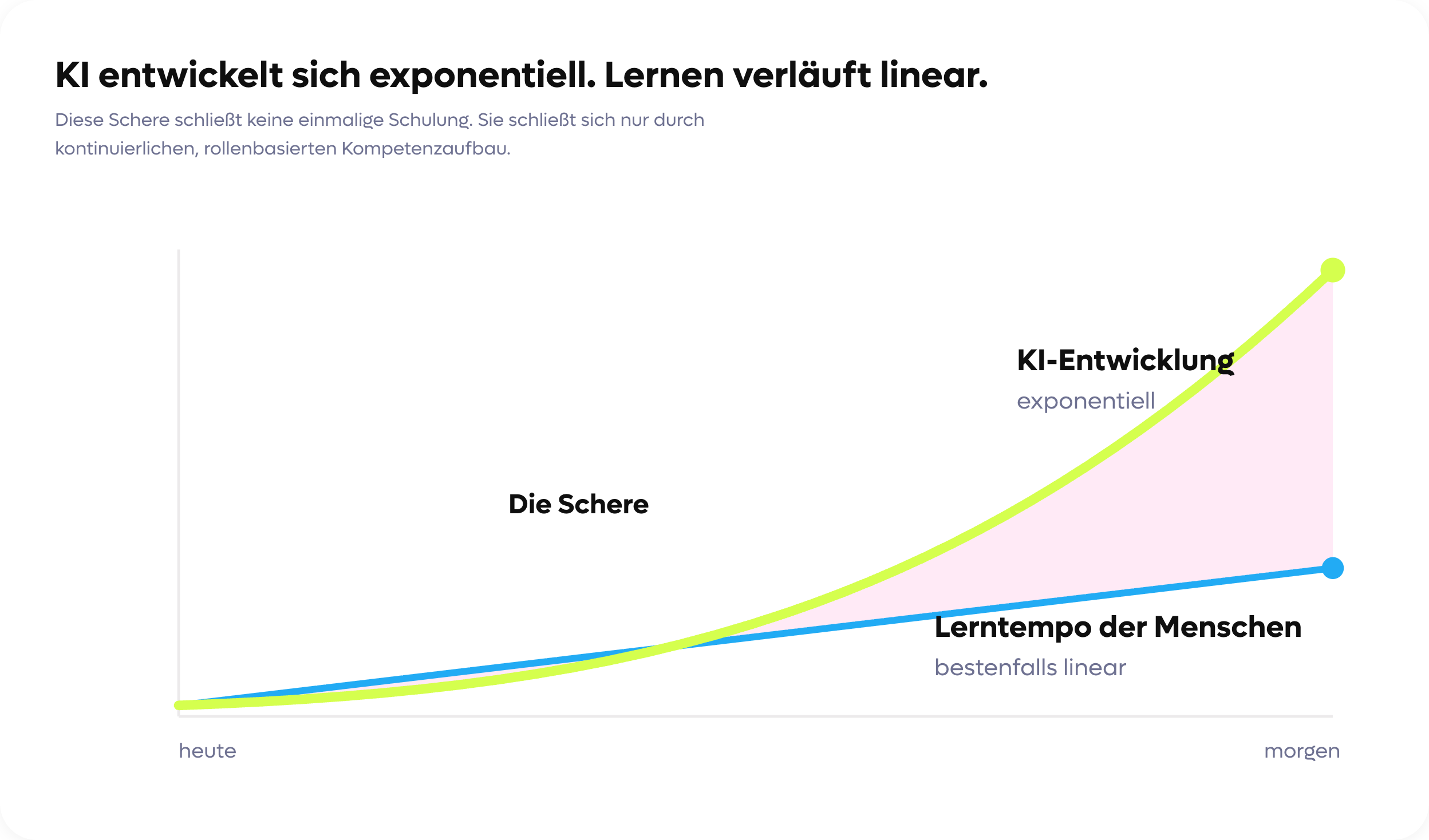
The answer lies in symbiotic collaboration with AI. This means not only building expertise on how the tools themselves work, but also understanding how they are transforming one’s day-to-day work. In practical terms, this means a break from a cherished habit for many organizations: people who are currently stuck in a specialist career path must develop leadership skills and redefine their identity. A shift away from “I’m an expert in X” toward “I delegate parts of it to AI and manage the outcome.”
It is precisely this shift that many organizations still do not understand, even though it is the very heart of the transformation.
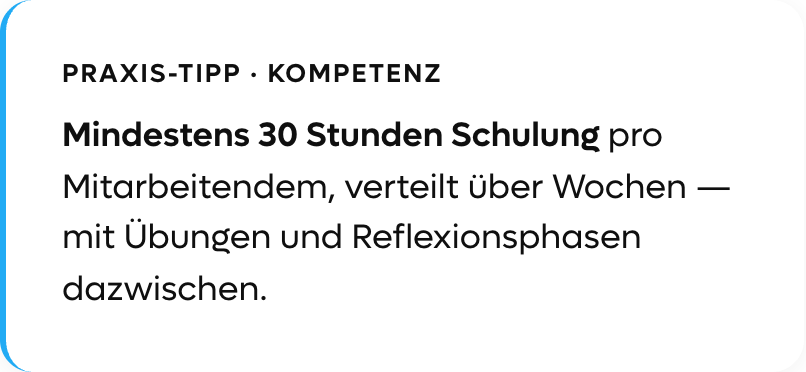
It makes sense to focus on role-based training rather than broad training: Who will take on which role in the transformation, and what specific skills does that person need for it? The people trained in this way should then be brought together in a real AI community—not in an informal group that meets for coffee on Fridays and chats a bit about AI. A community needs a clear distinction between insiders and outsiders—in other words, access restrictions. Those who are allowed in must also meet clear expectations.
Mistake 3: Why Focusing on Efficiency Is the Wrong Metric
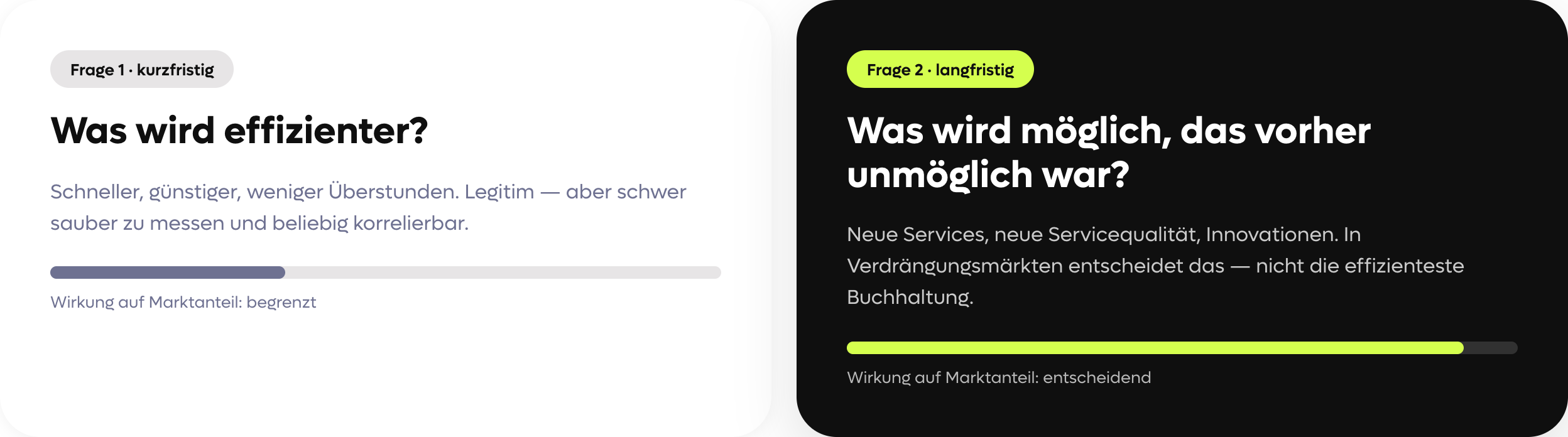
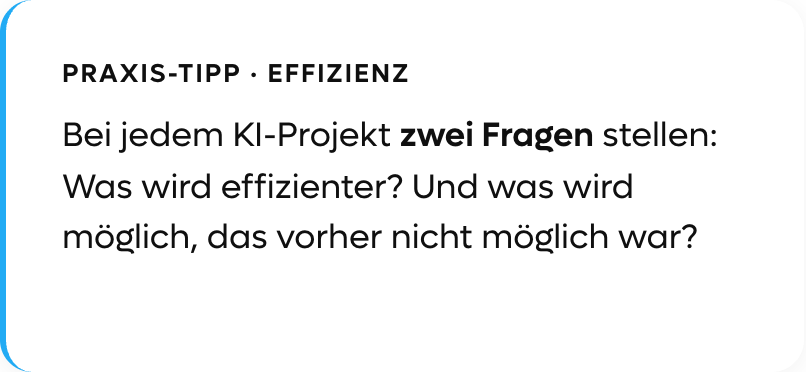
Last but not least, many executives and organizations naturally have their sights set on massive efficiency gains. There’s nothing wrong with that, especially in challenging economic times. Nevertheless, this is the more difficult perspective to adopt, because most companies still lack the right metrics to reliably measure the impact of AI and its actual ROI.
In practice, it often looks like this: If employee turnover decreases, it’s attributed to AI. If satisfaction increases, it’s attributed to AI. If overtime decreases or the quality of output improves—as measured, for example, by reactions on LinkedIn—that, too, is attributed to AI. In many cases, we have to be honest and say: No, there’s no way to prove that. It’s very difficult for organizations to measure this.
The second reason why we should focus less on efficiency lies in the maturity level of our own AI usage. The first step is always short-term in nature. In the long run, however, cutthroat markets are about something else: You don’t gain market share through the most efficient accounting, but rather by being able to create new forms of value. These can include new service offerings, a different level of service quality, or innovations that would not have been possible before.
For us, for example, that’s our learning tutor Lea: an AI that lets you share your screen and work together in co-creation, such as to build an automation. And then there’s this: available 24 hours a day, 365 days a year, in all languages, and knows every AI tool better than its own documentation. These are things that simply wouldn’t have been possible before, and it’s precisely these kinds of offerings that ensure the long-term success of this technology within the company.
What's Still Missing
Leadership, competency development, and a focus on efficiency are three of the patterns we have observed among many corporate clients over the past few years. There are two others that occur just as frequently:
Mistake 4 – Task forces that plod along without sharing their knowledge throughout the company.
And Mistake 5 – an IT department that becomes a bottleneck instead of enabling innovation.
We answer these questions in our free white paper, “The 5 Biggest Mistakes in AI Transformation.” There, you can read a detailed breakdown of all five patterns and get a checklist that will help you see where your company currently stands in just a few minutes.

Conclusion
Three observations from three years of working with corporate clients lead to a single conclusion: AI transformation does not fail because of ChatGPT, Copilot , or Claude. It fails because of a lack of leadership by example, a “scattergun” approach to building expertise, and a focus on efficiency that obscures the view of true value creation. The technology has long been here. The question is whether your organization is ready to truly put it to use—starting with you.