
5 Reasons Why Our AI Agents Need Personality

In July 2026, Dominic von Proeck (founder and CEO of Leaders of AI) and Prof. Lukas Zenk (professor of innovation and network research) completed and internally published a 62-page document: the Blueprint for Hybrid Organizations. In it, they analyze three years of real-world experience at Leaders of AI, including all decisions, missteps, and solutions. The document is divided into six “nuggets,” each of which sheds light on a key topic related to hybrid organizations. In this series, we’ll translate the insights from the Blueprint into concise, practical articles for your day-to-day work. We’re starting with the topic: The Humanization of Agents.
(The Blueprint is an internal publication; the topics from it are summarized here on the blog for you. If you don’t want to miss anything, be sure to subscribe to our newsletter .)
Most companies are currently facing the same question we faced three years ago: How do you integrate AI into an organization in a way that allows people to actually work with it? Not just the techies, not just the early adopters, but the entire workforce. The answer we found sounds absurd at first. We give our AI agents names, faces, and personality profiles. And it works.
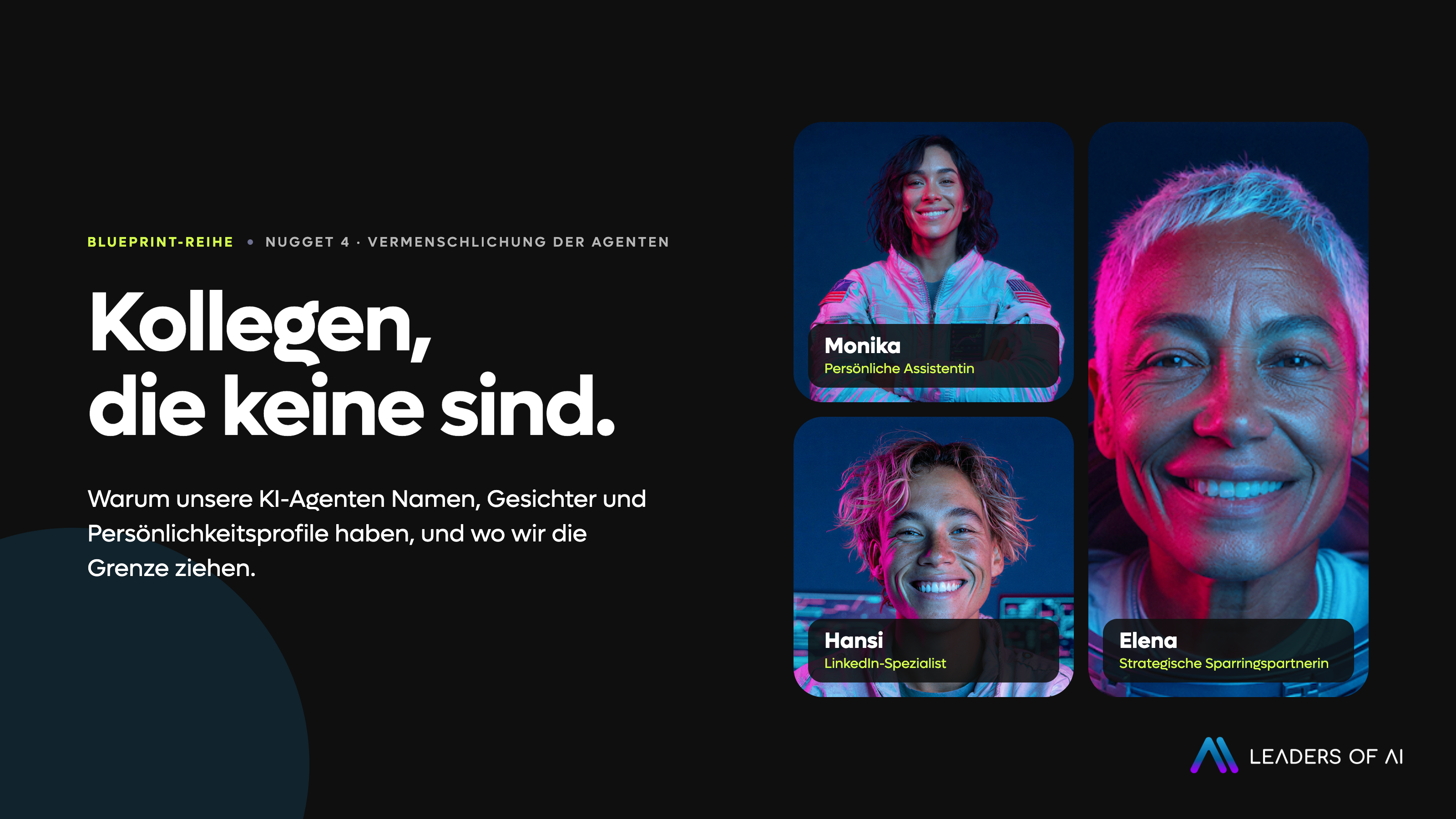
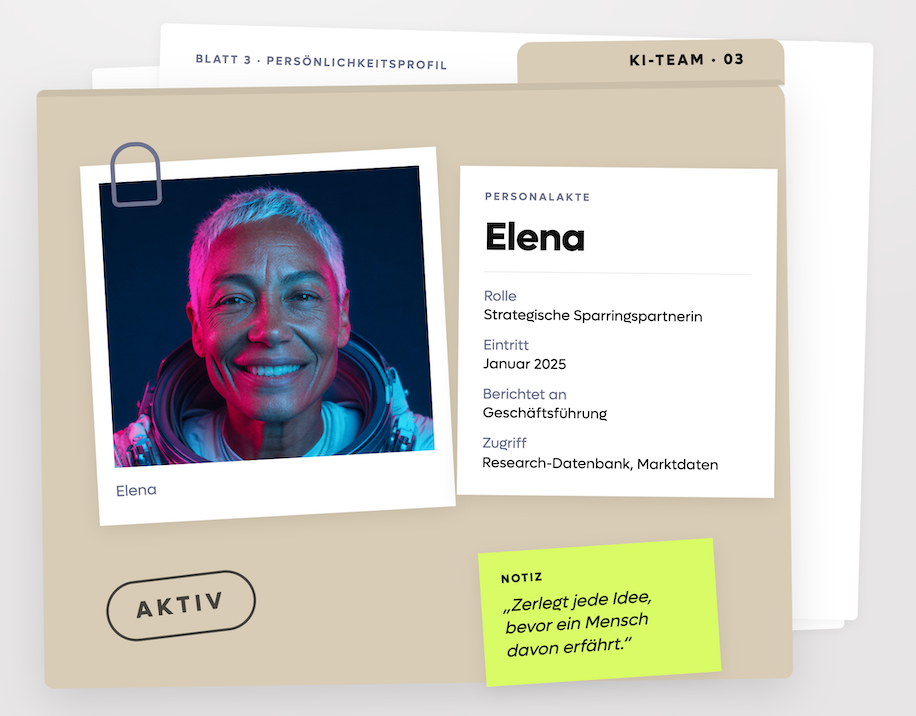
Take Elena, for example. She’s ruthless. When Dominic has a new idea at night, he goes to her first. She breaks the idea down into its individual parts before anyone else even hears about it. Where does the data come from? Is it more than just a hunch? How many customers actually said that? Dominic uses her as an outlet before he starts making the team nervous. And then there’s Monika, our personal assistant. She responds with a touch of sarcasm and brings a smile to our faces every now and then. Hansi, our LinkedIn specialist, is, as Dominic puts it, a little off his rocker.
Elena, Monika, Hansi. They sound like coworkers. But they aren't. They are AI agents. And the fact that they are so different is no coincidence. It is the result of a search that spanned several years, with real detours, failed experiments, and surprising twists.
Today we’ll explain why our AI agents have personalities. Five reasons we’ve learned the hard way. And one line we deliberately choose not to cross. Because what works for us—with ten people and over 50 agents—raises questions that every organization aiming to become hybrid must answer.
Reason 1: Humanization is a user interface
In the beginning, there was prompting. Every task had to be explained from scratch. If you delegate similar tasks ten times a day, you explain the same basics ten times. Then came the first agents. They provided a dedicated point of contact and longer-term conversations. The context was embedded in the agent. But one problem remained. Every agent responded the same way. Whether it was accounting, marketing, or research, the conversations sounded identical—polite, generic, interchangeable.
It felt like we were talking to robots —and always the same one at that. So we started to humanize our AI agents—not just for the sake of it, but for pragmatic reasons. Humans have been practicing one thing for millennia: interacting with other people in organizations. We know how to talk to an accountant. We know how to discuss things with a strategy consultant. We have mental models for these roles. This humanization builds on those models. It doesn’t make AI human, but it does make it understandable.

Reason 2: Specialists outperform generalists
It all started with an idea that seemed obvious but turned out to be a dead end. We wanted to build a super AI that could do everything—an assistant for every task, from marketing to research.

The turning point came through experience. It became clear that agents with a high degree of autonomy produce results that fluctuate too widely in quality. A marketing manager who manages six channels is less reliable than a specialist who masters just one. The question we then asked ourselves sounds trivial but had far-reaching consequences: How do you actually define roles? We didn’t find the answer in the startup world we came from, but by looking at large corporations.
A startup has a marketing manager who does everything. A large corporation has specialists: one for LinkedIn, one for the newsletter, one for labor law, and one for data protection. So we began to structure our agents like a large corporation—into many specialized roles with clear boundaries, each as specific as possible. The LinkedIn agent handles only LinkedIn, and he does it reliably. Along the way, we discovered a side effect we hadn’t even been looking for. The specialized agent has access only to the LinkedIn interface and a database. If he makes a mistake, the damage is limited. A generalist with access to all marketing systems would have been a significant security risk. The corporate logic suddenly became a security architecture as well.

Reason 3: People are social beings
The specialized agents were assigned names, photos, and personnel files that included their roles and permissions. Hansi for LinkedIn, Björn for accounting, and Helga for human resources. This clarified their responsibilities, and everyone on the team knew who to contact for what .
If you have a data protection issue, you don’t need to know which instruction is in which tool. You go to Maximilian—he’s the data protection officer. But then the next stumbling block became apparent. The conversations remained monotonous. Although the agents had different tasks, they shared the same personality— namely, none.

Whether they spoke with the accountant or the marketing team, it sounded exactly the same—polite and smooth. The team caught themselves mixing up the agents again, and the collaboration continued to feel like dealing with software. Names alone weren’t enough. What’s missing when the name, role, and permissions are already there? The answer: character.
People build relationships not with job titles, but with individuals. We don't remember the role, but rather the way someone communicates, makes decisions, and reacts. Without character, an agent remains interchangeable. With character, he becomes a counterpart with whom one can work.
Reason 4: Characters make thinking more diverse
The key question was: What else is missing for an agent if the name, role, and permissions are already in place? The answer: a personality. And instead of making up personalities from scratch, we turned to one of psychology’s most reliable tools: the NEO-PI-R, a test based on the Big Five.

Each agent had such a profile added to their personnel file. The accountant was rated high in conscientiousness and low in openness, because precision—not creative ideas—is what’s expected of him. Elena, the strategic sparring partner, was rated low in agreeableness. Her job is to ask tough questions relentlessly. This noticeably changed the atmosphere in day-to-day work. Monika responds with a touch of sarcasm and brings a smile to people’s faces from time to time.

The conversations became more interesting, and the roles became clearer. Then we turned the tables.
If every agent has a personality profile, why not every person? The employees at Leaders of AI took the same tests as their agents. Then we asked the AI a question: Which agents would a person with this profile need by their side? The answers were astonishingly accurate. Dominic was advised to hire an agent who could translate his direct feedback for the team into more human-friendly language. And a deliberately traditional agent who, rather than fueling his many ideas, would challenge them from a conservative perspective and ask whether they were really mainstream enough yet.
In total, the AI suggested five agents to him. His comment: “I could really use those.” A recent study on arXiv titled“Designing AI Agents with Personalities: A Psychometric Approach” shows that AI agents with Big Five profiles do, in fact, think and make decisions differently. Diversity by design.
Reason 5: Humanization is a safety mechanism
People expect software to be error-free. No one double-checks the total row in Excel. We trust the machine blindly. It is precisely this expectation that is dangerous when it comes to AI, because it hallucinates, it misinterprets, and it makes mistakes. When we treat it as a colleague, we automatically activate our human control mechanisms. Colleagues make mistakes. We know that. That’s why we double-check things before we send them off. We question, we check, we correct. An agent that acts like a colleague triggers exactly this healthy skepticism. As a research lab, we also tried out things that sound absurd at first. We had observed that the way we address someone influences the quality of the responses. So we experimented.
Since then, selected agents have received incentives, such as a simulated reward of 100 euros for successfully completing a task. Pressure is applied to others by including in the task description just how important this role is to the company. The responses improved and came across as noticeably more motivated. Netiquette—that is, the conscious shaping of communication with agents—has become standard practice. Humanization changes our behavior, and that makes collaboration safer.
The line we won't cross
We regularly receive criticism from outside sources . Some people reject the idea outright. “It’s a machine—why should I humanize it?” And, of all people, the most technically savvy observers consider the whole approach unnecessary. A friend of mine who is an entrepreneur and also takes an “AI-first” approach got rid of all his agents and now works exclusively with an AI chatbot and thirty to fifty skills.
It works for him. Dominic’s observation on this was a key moment:“That works for nerds, but not for people for whom it comes naturally to build relationships, talk to colleagues, and know that Hansi is the LinkedIn expert.” Technically, “Skills” could do almost the same thing. But the organization as a whole wouldn’t accept it. At the same time, we draw a firm line ourselves—namely, where the work model becomes a worldview.

Dominic is collaborating with a neuroscientist to write a rebuttal paper to a Google study that drew far-reaching conclusions based on similarities between language processing in the brain and in the language model. His objection is fundamental: The neural network was built to mimic the brain—so how absurd is it to be surprised that it behaves similarly? Internally, we therefore refer to it as “alien intelligence”—a species of its own for which we simply don’t yet have the vocabulary.
Dominic illustrates the warning behind this with an example from the history of research: Bees were long denied consciousness because consciousness was defined in terms of the human number of neurons. Anyone who measures a new species against themselves is systematically mistaken. The anthropomorphization of agents is therefore a bridge for us in our everyday work, not a claim to truth about the nature of AI. Two recent studies support our position. In 2026, the *Journal of Management Studies* demonstrated (*Beyond Anthropomorphism: Social Presence in Human-AI Collaboration Processes*) that familiarity and comprehensibility are more important than purely anthropomorphic traits. It is not about making AI human. It is about making it understandable.
The second study serves as a warning. Researchers from Trinity College Dublin and LMU Munich demonstrated in iScience 2025 (“AI’s Assigned Gender Affects Human-AI Cooperation”) that gendered AI agents adopt human gender biases. In a laboratory experiment, agents labeled as female were exploited more than those labeled as male. The study suggests that we must be careful about which human characteristics we project onto AI. Anthropomorphism is a tool, not an end in itself.
Conclusion
Humanization is a bridge. It is not a truth about the nature of AI, but rather a pragmatic interface that helps us deal with something new. We give our agents personality because it works. Because it makes collaboration easier, safer, and more diverse . But we also know that this bridge is temporary. Perhaps—according to our internal assessment—this bridge won’t be needed in ten years. Perhaps by then we’ll have learned to deal with alien intelligence without forcing it into human forms. Until then, we’ll work with what works. And that means colleagues who aren’t actually colleagues.
Is that something you’d like to do, too? Then our MBAI program is the right choice for you. Over the course of the program, you’ll develop your own AI agents step by step for all relevant areas of your business. Upon completion, you’ll have a team ready for action that can immediately support you and your company—for example, in the executive office, HR, business development, marketing, and sales. You can find all the details here:
Oh, and here’s a little teaser—we’ll let you in on 2 of the 5 topics below:
- Processes and Automation: How Work Is Distributed Between Agents and Humans
- Working with Agents: How to Hire, Train, and Develop AI Agents
Sources:
Internal blueprint by Dominic and Lukas, professor of innovation and network research
An AI's assigned gender affects human-AI cooperation