
Have AI academies had their day?

If AI models are becoming easier and easier to use, why do we even need AI training programs anymore? Specifically, the kind we offer here at Leaders of AI. Will our company soon be as obsolete as phone books, floppy disks, and cassette recorders?
This isn't a rhetorical question. It's real. And it doesn't come from outside, but from our own circle. From friends who put off our course. From companies that would rather "wait until 2027" instead of getting started with AI. From people who believe that in a year, AI will be so easy that training won't be necessary anymore.
We've looked into this question and are sharing 5 really good (data-backed) reasons why high-quality AI academies aren't redundant.
5 Reasons Why AI Training Will Continue to Be Necessary in the Future
1. AI is becoming easier to use but harder to manage
Yes, AI tools are becoming more intuitive. Soon, you’ll just say, “Go ahead,” and the AI will do it. But for the AI to do the right thing, you need to know what“right” actually means. You need to be able to break down your work processes into clear steps, define when a result is good enough, and recognize when the AI is producing nonsense. This isn’t a technical skill like prompting —it’s a leadership skill. And it doesn’t get any easier just because the tools are getting better.
2. Usage Does Not Equate to Competence
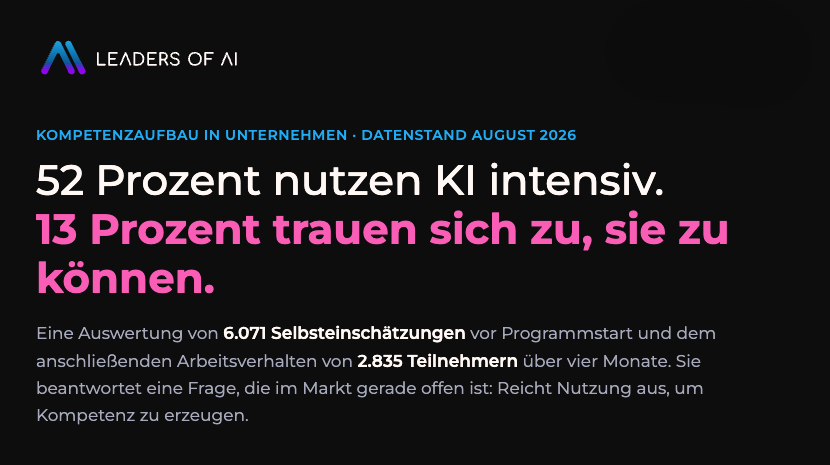
Just because you use Claude, Gemini, or ChatGPT every day doesn’t necessarily mean you’re good at it. Our internal study of over 6,000 participants shows that 52 percent use AI intensively, but only 13 percent feel confident that they truly know how to use it. 720 people reported using AI at the highest level while at the same time rating their competence as only average. So, daily AI use is no guarantee that you know how to deploy AI strategically, spot errors, or build agents. It’s like driving: You drive to work every day as a matter of routine, but that doesn’t make you a good driver who reacts correctly in critical situations. (Note: You’ll learn more about our study soon—stay tuned.)
3. Organizations have strategies but no implementation
Almost all companies have an AI strategy on paper. But only 39 percent are actively managing AI at the top management level (Source: KPMG, Generative AI in the German Economy 2026). Even more striking: 84 percent of companies plan to automate at least ten percent of their jobs over the next three years, but have not yet adapted their job descriptions (Source: Deloitte, State of AI in the Enterprise 2026). The technology is there, the strategy is there, but no one has prepared the organization for it. No clear responsibilities, no governance, no new ways of working. AI academies like Leaders of AI teach exactly that: how to transform organizations, not just install tools.
4. Complexity shifts; it does not disappear
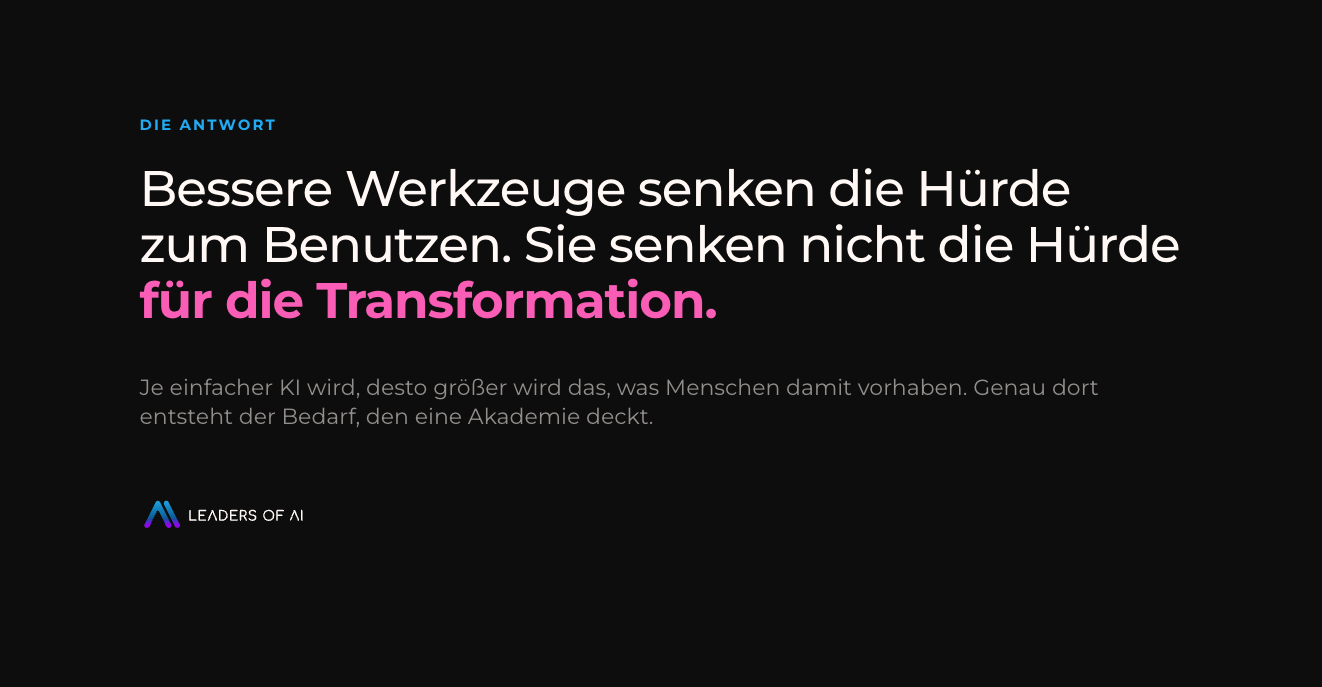
Complexity doesn’t disappear—it shifts. In the past, you had to understand the technical aspects of how to create prompts. Soon, AI will handle the prompting itself. But then you’ll need to understand the strategic aspects: What do I actually want? Which processes should the AI take over? How do I know if the result is good? Better tools lower the barrier to entry. They don’t lower the barrier to transformation. The simpler AI becomes, the greater the scope of what people plan to do with it. That’s exactly where the need arises—a need that an academy fulfills. Those who wait now will miss out not only on time, but also on the learning curve and the understanding of how to lead AI—not just use it.
5. AI academies don't teach technology; they teach how to use it
A good AI academy today no longer teaches you how to use ChatGPT, but rather how to break down your work processes so that AI can take them over. Or how to define your quality standards so you can tell if the AI is performing well. How to identify patterns so you can understand when AI works and when it doesn’t. And how to manage AI agents so that you’re not just using a tool, but can build a hybrid organization made up of people and agents. The fact is: The tools change every six months, but these principles remain the same. And those are exactly what you need to learn.
How We Learned This Ourselves
We at Leaders of AI don't just know this from theory. We know it because we've lived through it. A look back.
November 2022. Dominic (co-founder of LOA) asks ChatGPT a harmless question about preparing for a chess tournament. Three years later, with a team of 8.5 people and over fifty AI agents, we’re generating 13 million euros in annual revenue. But the path to get there wasn’t a straight one—it was a constant experiment.
Practice what you preach
From the very beginning, we had one rule: We would never have more than ten people. Everything else is handled by AI agents. Not because we’re tech-obsessed nerds, but because we wanted to understand how a hybrid organization really works.
That was what set us apart: Practice what you preach. We don't teach what we've read. We teach what we do every day—and where we fall short.
Monika, our AI agent, fails at the Deutsche Bahn portal. Other agents suddenly start spouting nonsense. But that's exactly the point: We want to know where the limits lie—not in the hype, but in practice.
Sell Before You Develop
January 2024. We’re launching our first course. Or, to be more precise: we’re selling it. At this point, all we have is a single PDF page describing the course. That’s it. No finished product. No videos. No assignments.
The first cohort begins on January 14, 2024. We’ll be developing the course as it progresses—about a week ahead of the participants each time.
Sounds crazy? It was, too.
But it was the best decision we could have made. Because the feedback came in real time from paying participants, not from test subjects. The first case study? A complete disaster. It took participants forty hours to solve it. It wasn’t until we went through several iterations over the course of the three-month program that we were able to scale it down to a level that was appropriate for the target audience.
If you wait until everything is perfect, you don't just waste time. You miss out on the learning curve. You miss out on your organization beginning to recognize patterns. You miss out on your people learning to deal with uncertainty.
Helga writes better prompts than we do
Here's an example that surprises most people.
In 2023, we developed our own prompt framework. The ACTION principle: research-based, clearly structured. Back then, it really helped us get better results out of ChatGPT. We were convinced that everyone needs to learn how to prompt effectively.
Today, we're letting the AI write the prompts itself.
We have Helga, our AI recruiter. When we want to bring a new AI agent onto the team, Helga asks us the typical hiring questions: "What tasks will the agent be responsible for?", "Where in the company will the agent work?", "What personality traits should the agent have?"
Helga then uses the responses to create the prompt that serves as the basis for this new agent. The quality is 90 to 95 percent that of a prompt expert—without us having to spend hours fine-tuning the wording.
The real skill isn't writing perfect prompts. The real skill is being able to judge whether a result is good— whether the AI has understood what you want, and whether the output is useful or nonsense. No framework can teach you that. You can only learn it through experience.
The pattern repeats itself
We've come this far and moved this quickly in harness engineering today because we had already understood the principle behind prompting. We see a pattern, and that pattern is repeating itself again. It's just combined a little differently from a technical standpoint.
But actually, harness engineering is exactly the same process as prompting: testing, doing it by hand, building initial systems—then the AI takes over. It’s always the same cycle. That’s what the “wait-and-see” crowd doesn’t understand. Because this very part won’t disappear even in 2027. The complexity isn’t going away—it’s just shifting. From technology to leadership. From operation to understanding. From execution to strategy.
The span of control also applies to AI
Here's something we didn't realize until two years later: AI agents have a span of control.
Dominic limits his active relationships to about 10 agents that he uses intensively at any given time. More than about 10 close working relationships (with people and agents) are unmanageable. Anything beyond that must be delegated to a coordinating agent.
That's not a technical limitation. It's a human one.
And that’s exactly the point: The smarter AI becomes, the more important leadership skills become. Not prompting. Not technology. But the ability to clearly articulate what you want. To distinguish quality from junk. To lay out processes.
That's leadership. And it doesn't get any easier just because the models are getting better.
So: Do we still need an AI academy?
Yes. More than ever. Not because the technology is complicated. But because the questions it raises are complicated.
Not because you have to learn how to give prompts. But because you have to learn how to lead.
Not because AI is hard to use, but because it's hard to know what you actually want.
And that is exactly what (making processes explicit, formulating quality standards, understanding patterns) an AI academy teaches today.
It's not the technology. It's how we use it.
And that's not going to get any easier. It's going to become more important.
Sources:
- Leaders of AI, Internal Study 2025/2026 (6,071 participants)
- KPMG, Generative AI in the German Economy in 2026
- Deloitte, State of AI in the Enterprise 2026
- Internal Transcript: Leaders of AI, Nugget 7 "Organization – The Origins of LAI"