
Have AI academies had their day?
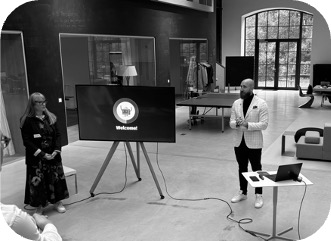

Knowledge alone changes nothing. AI only becomes effective in a team when leadership, routines, and application work together.
Many companies invest in AI training. But in day-to-day work, little often changes afterward. The problem isn't a lack of content, but rather learning formats that never translate into practical application. AI academies aren't obsolete. But course libraries without implementation certainly are.
Are AI academies obsolete?
In short: no.
Formats that simply store knowledge and confuse impact with completion rates are outdated. A certificate doesn't tell you whether your team makes better decisions, handles data responsibly, or uses AI effectively in daily operations.
If, after a training course, no one knows which tasks are permissible with AI, who checks the results, or what good everyday use looks like, little of the learning remains. Knowledge has been disseminated, but no work methods have changed.
This is precisely where it gets expensive. Companies buy content and then wonder about low usage, data privacy concerns, and slow team adoption. Often, the problem isn't a lack of content, but rather a clear framework for its application.
Why pure AI training often fizzles out
Many AI programs don't fail because of the video quality. They fail because of the lack of transfer.
When learning is separated from daily work, almost always the same thing happens: employees look at content between meetings, test a tool once, and then fall back into old routines. Not out of resistance, but out of sheer necessity.
Knowledge alone doesn't create a habit. Habits develop through application, feedback, and a clear framework. Without this framework, AI education remains a neatly organized mess. Login without consequences for processes, collaboration or leadership.
Our practical experience shows that the impact is particularly weak where programs focus solely on content quantity – meaning lots of videos, logins, and certificates, but little live interaction, feedback, or commitment in real-world use cases. This isn't an external study, but rather our observation from working with companies and building our own hybrid organization.
What a good AI academy must offer today
If you want AI to have an impact in business, education today needs four things.
- Learning must be implemented in the workplace.
A good program doesn't end with understanding. It leads to real-world applications – for example, better meeting preparation, faster research, initial drafts of proposals, or clearer internal communication. - Leadership must provide the framework
Someone needs to clarify what AI should be used for, what applies to sensitive data, how good results are recognized, and who bears responsibility. Otherwise, uncertainty remains. And uncertainty hinders its use. - Community accelerates adoption
New ways of working rarely emerge in isolation. They arise where people see examples, can ask questions, and learn from each other. That's precisely why one-off training sessions often have no lasting impact. - Content must grow with reality.
AI is changing rapidly. Good education is therefore not a static stack of videos, but a system with updates, live elements, and feedback from real-world applications.
Our practice at Leaders of AI
At Leaders of AI, we don't build an isolated learning environment. Our programs are born from real-world application. We work with over 50 AI assistants, operational workflows, and European tool setups. If we teach something, we've tested it in our own daily work.
A concrete example: When we switched our programs to European tools, we didn't just have to replace slides. We had to rebuild exercises, tool workflows, and parts of our internal processes. This shows whether a program merely informs or actually changes ways of working.
How to recognize effective AI training
Before you book your next program, check these five questions:
- Does the learning process lead to concrete applications from your everyday life?
- Is there feedback, live elements, or interaction with others?
- Are leadership, responsibility, and quality standards taken into consideration?
- Is the content constantly updated?
- After completing the program, are you able to complete tasks faster, more safely, or more clearly than before?
If you answer "no" several times here, you're probably buying knowledge as a precaution. That sounds reasonable, but it doesn't change much.
Conclusion
AI academies are not obsolete. But educational formats without implementation are.
Good AI education doesn't just inform. It changes everyday behavior. It creates routines. It makes leadership more concrete and collaboration better. That's exactly how you should measure every program.
If you want to not only understand AI as a team, but also make it manageable, you need a format that brings together learning, application, and responsibility.
That's exactly what our programs are built for. The MBAI is for Self-employed individuals This program is designed for executives who want to strategically integrate AI and implement it with clear use cases. The AI Survival Program is the right starting point if you want to quickly build your first AI assistants and use them confidently in your daily work. Both formats focus on practical application, community, and continuous updates rather than simply storing content.