
Insights from Silicon Valley: Is Europe Really Falling Behind in AI?


Silicon Valley, in the San Francisco area, is considered the world’s high-tech hub. And few places have such a profound impact on AI development: Companies like OpenAI, Anthropic, and Google are based here, and this is where the models we all work with are created. But anyone who thinks that everyone there has long since figured out how AI transformation works is mistaken. That’s the key takeaway from a series of conversations our co-founder Dominic has had over the past few weeks.
In this article, you’ll learn why even companies with billion-dollar budgets and the world’s top talent are struggling to make progress with AI transformation—and what everyone in Silicon Valley is desperately searching for right now. You’ll also discover three strategies you can implement immediately in your company.
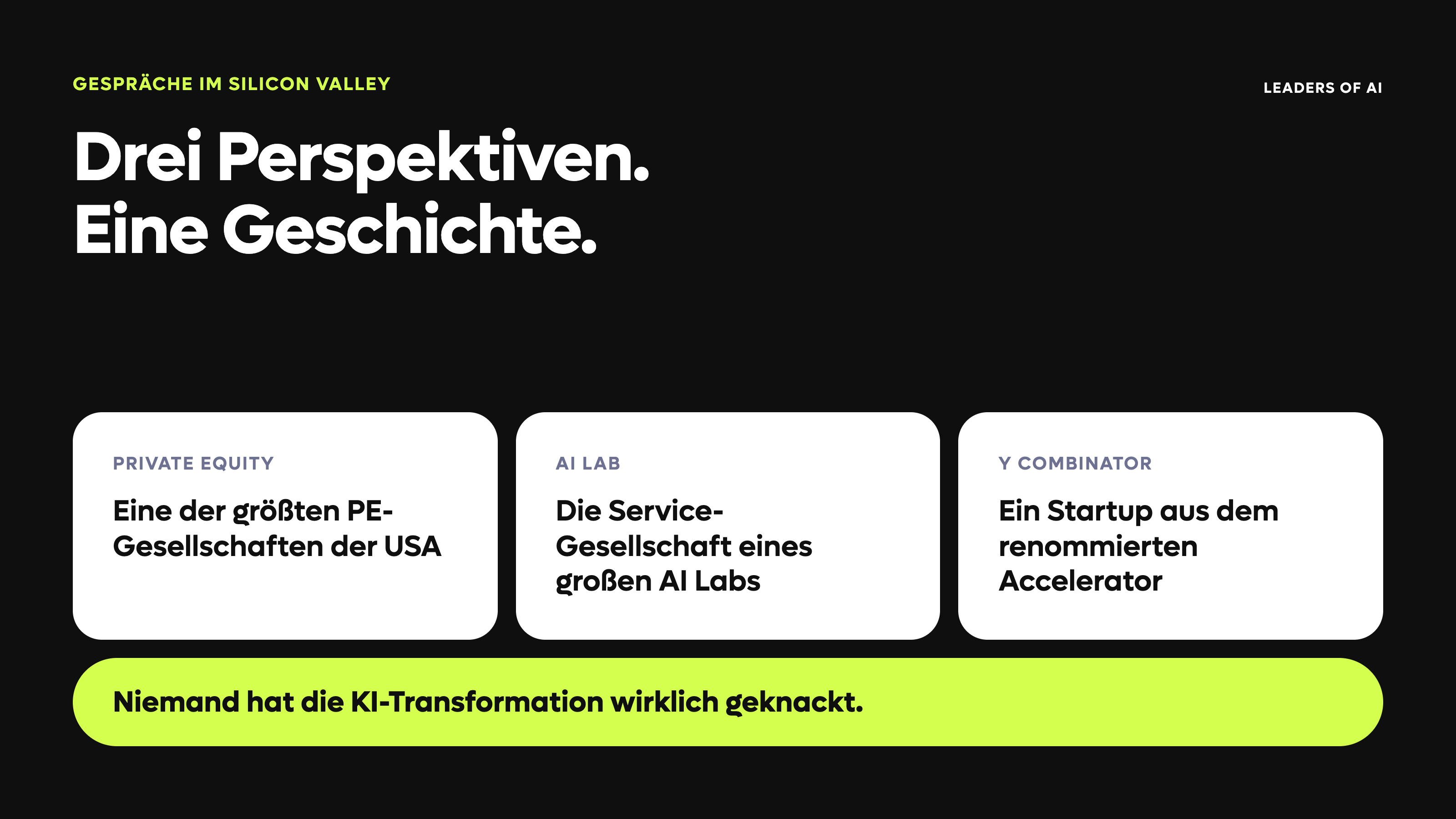
We are not allowed to mention names. But we can mention the categories, and they show just how broad the picture is:
- One of the largest private equity firms in the U.S. It has acquired numerous hypergrowth companies and supported their growth. There is an enormous concentration of highly valued companies there.
- The service arm of one of the major AI labs. Its mission: to find out how AI is actually being adopted in organizations.
- A startup from Silicon Valley that is part of Y Combinator. The accelerator is considered one of the most prestigious in the world. Sam Altman led it before moving to OpenAI.
So, three very different perspectives. And yet, at their core, all three tell the same story.
Insight 1: No one has really cracked the AI transformation
AI transformation is currently the biggest challenge worldwide. No continent has figured out how to make it work reliably—not even in Silicon Valley.
This is illustrated by an example from the Y Combinator startup. Technologically, the team is extremely advanced—significantly more so than we are at Leaders of AI. It focuses on what are known as AI software factories.
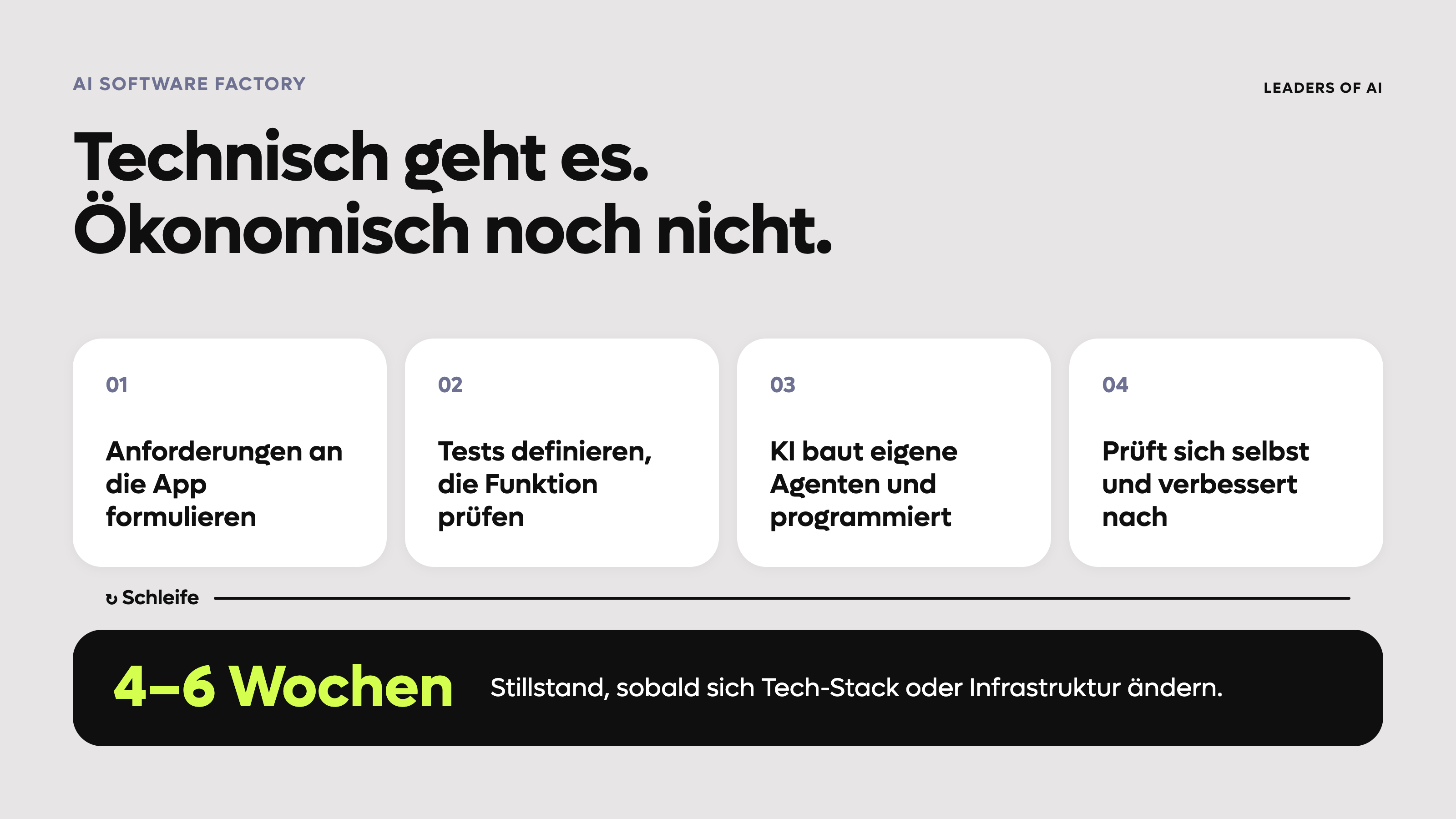
The principle:
- You define the requirements for an app: what it should be able to do and what it should look like.
- You define tests that can be used to verify that the app works.
- The AI uses this to build its own AI agents, programs them, evaluates them using the tests, and refines them. This creates a loop.
That's pretty much the highest level of productivity one can imagine right now. And it works.
Until something changes. Because as soon as the tech stack shifts or new infrastructure requirements arise, the system grinds to a halt. It then takes the team four to six weeks to get the factory up and running again. The founders are therefore asking themselves an uncomfortable question: Couldn’t we have built solutions that were at least as good during those weeks by working with AI, instead of keeping a tech demo alive?
The answer they give themselves: Technically, it's possible. Economically, they're not there yet.
Insight 2: The Valley is trying to solve the problem with money
American companies experiment a great deal. They try out countless projects at the same time, and many of them disappear just as quickly. Software is launched, fails to keep up with the competition, and is discontinued just as quickly.
This speed is a strength. However, it masks a problem: Many companies have not yet realized what results they actually need to demonstrate with AI in order for models and licenses to pay off in the long run.
It’s fascinating to see how the AI Lab’s service company operates. It relies on two pillars:
- Education: Employees must be empowered.
- Forward-Deployed Engineers: by far the largest pillar. Developers work directly on-site with the client, building data pipelines and implementing workflows.
The team is aware that it needs to engage and train people. In practice, however, the focus is clearly on technology. People are taken into account, but they are not the central focus.
Insight 3: The bottleneck is people, not technology
None of the discussions brought up a truly innovative approach to getting people on board for the long term. How are structures changing? How are roles changing? How must identity and mindset evolve so that an organization with AI agents actually becomes more productive?
These questions remain unanswered, even among the biggest players. Even corporations like Meta, with the best talent and a virtually unlimited budget, are realizing that money alone cannot buy transformation. (More on this: here.)
Insight 4: The stock market boom is deceptive
Anyone looking at the S&P 500, the most important U.S. stock index, might think that the AI transformation has long since been achieved. That’s a misperception. The upswing stems primarily from the infrastructure business surrounding AI: chips, data centers, and energy. It does not come from companies using AI productively in their day-to-day operations.
This is also confirmedby the latest market report,“State of Markets II,” from Andreessen Horowitz (a16z), one of the world’s most renowned venture capital firms. According to the report, by the end of August 2026, approximately 76 percent of earnings growth in the S&P 500 came from the tech sector. At the same time, while 69 percent of S&P 500 companies report using AI, only about 2 percent actually disclose any measurable metrics related to it (summary of the report available on ChainCatcher). AI is thus widely adopted but not deeply integrated.
The situation is quite different for companies built with AI from the very beginning. According to the same report, the median age of new unicorns—that is, startups with a valuation of over one billion dollars— fell from about 7 years in 2019 to about 4 years in 2026. An AWS study finds that AI-native startups reach a billion-dollar valuation in an average of 3.5 years, with teams half the size of those in the past (AWS Engines of Growth 2026, via Softprom).
So startups are shaking up the economy and proving that it can be done. Established organizations, on the other hand, can't keep up.
What this means for Europe—and for you
In Germany, we often hear that we’ve fallen behind in AI. That may be true when it comes to deep tech. It may also be true when it comes to infrastructure and foundational models.
But the game is far from over. The key question isn't who builds the best model. It is: Who can put that power to work? Who can successfully integrate AI into their organization in a way that pays off financially?
Even the Valley doesn't have an answer to that yet. And that's exactly why you should take one thing away from these conversations above all else: courage.
Here are three things you can do differently starting tomorrow:
- Start with the people, not the tool. Technology can be bought. Changing roles, new routines, and a different sense of self cannot.
- Miss, consider the impact of AI. When even in the S&P 500 only a fraction of companies disclose key metrics, you have a real advantage here.
- Build your own playbook. Document how you get started, where you make course corrections, and what works. This is exactly the kind of knowledge that’s in short supply worldwide right now.
🗒️ Note: Dominic will be traveling to the Valley again in the coming weeks, so we can look forward to more exciting insights.
Want to take the next step toward AI transformation today? Then our MBAI program is perfect for you. Learn how to build your own team of agents and integrate them into your daily work routine.

Sources:
- Discussions between Dominic and a private equity firm, the service company of an AI lab, and a Y Combinator startup (anonymized)
- Andreessen Horowitz: State of Markets II
- ChainCatcher: Summary of a16z State of Markets II
- Amazon: AWS Global Startup Trends Report, Press Release
- Softprom: AWS Engines of Growth 2026
- heise online: Major restructuring scrapped: Meta wanted to become “AI-native” but failed, according to a Reuters report