
AI Vocabulary: Terms You Really Need to Know
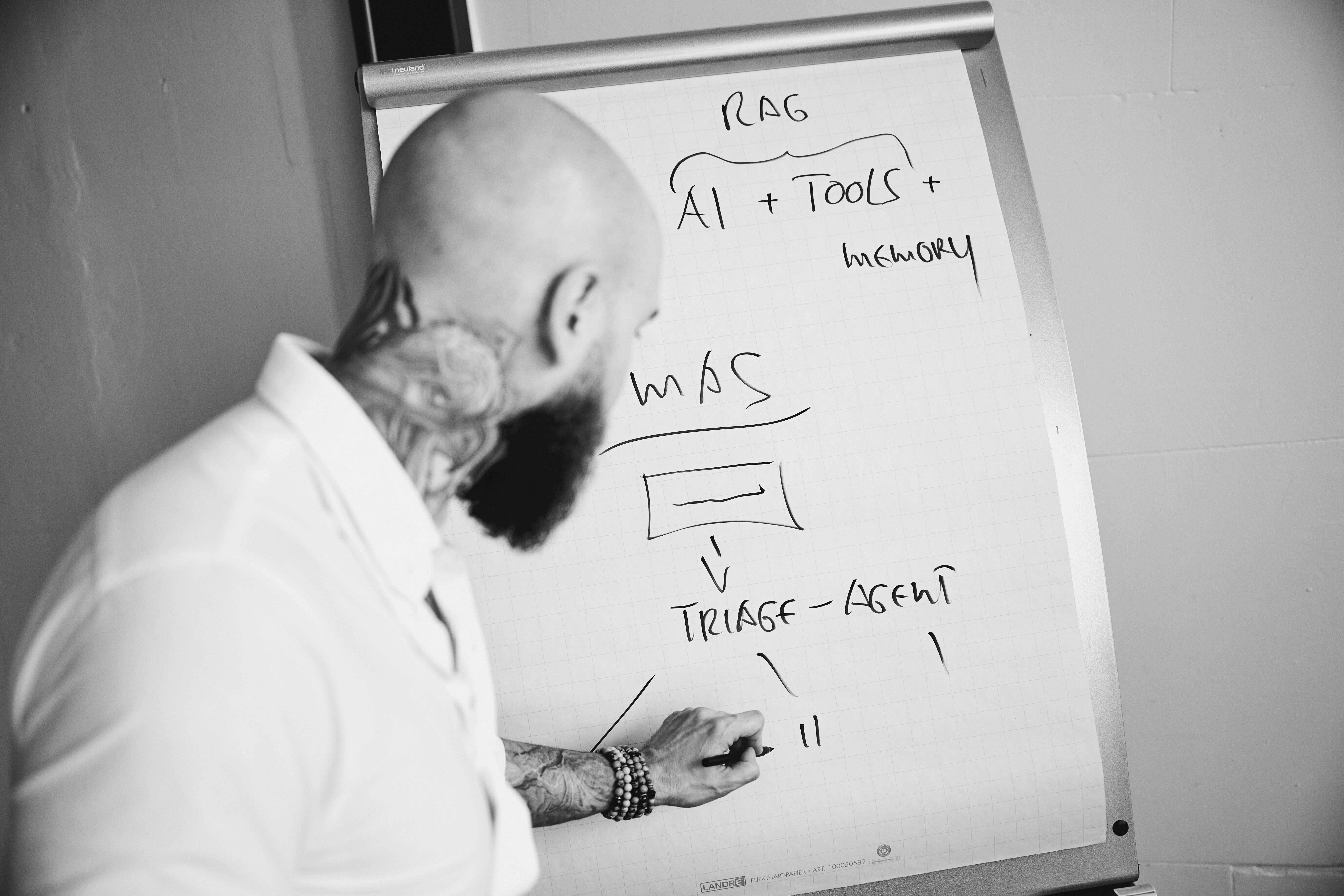
In almost every meeting on AI these days, the same words come up: agent, skill, automation, large language model. Often, everyone at the table uses these terms slightly differently, and by the end of the discussion, it’s unclear what was actually decided. This is a problem for executives, because decisions about AI investments, processes, and responsibilities require a common language. Those who understand the basic terminology will be able to contribute precisely to the next strategy meeting, ask critical questions, and distinguish hype from real value. Here are the terms that really matter.
Artificial Intelligence (AI)
Artificial intelligence refers to systems that perform tasks that previously required human thought: recognizing patterns, understanding language, making decisions, and generating text or images. The term is deliberately broad and ranges from simple algorithms to the large language models that currently dominate public debate. It’s important to keep in mind as a leader that AI describes an entire category of technologies, not a single product. If someone says in a presentation, “We’re now focusing on AI,” it’s always worth asking which specific application they’re referring to.
Large Language Model (LLM)
A Large Language Model (LLM ) is a language model that has been trained on vast amounts of text to statistically predict and generate language. Models such as Anthropic’s Claude fall into this category. An LLM does not understand meaning in the human sense. It uses probabilities to calculate which word best fits next, and has become so proficient at this that the results often seem more convincing than some texts written by humans. For executives, the most important practical implication is this: An LLM is the foundational technology upon which most of today’s AI applications are built, ranging from simple chat interfaces to complex AI agents.
Prompt and Prompting
A prompt is the input you use to give a language model a task—whether it’s a question, an instruction, or context. Prompting refers to the ability to formulate such inputs in a way that ensures the result is truly useful. It sounds trivial, but it isn’t: The quality of a prompt often has a greater impact on the result than the model itself. In many companies, prompting has now become a true core competency that should be developed just as systematically as Excel once became the office standard.
AI Agent
An AI agent differs from a traditional chatbot in that it does not merely respond to a single input, but independently plans and executes multiple steps. It can use tools, consolidate information from various sources, evaluate interim results, and adjust its approach until a goal is achieved. A chatbot answers a question. An AI agent researches a matter, creates a draft based on that research, checks it against defined criteria, and only responds once the result is complete. For managers, this difference is crucial because AI agents take on actual work tasks, thereby raising new questions regarding oversight, accountability, and quality assurance.
Skill
A skill is a package of instructions, examples, and sometimes scripts that an AI agent loads as needed to reliably perform a specific task consistently well, time after time. Without skills, you have to explain to an agent from scratch with every new assignment how a task works, what formats apply, and what exceptions there are. A skill stores this knowledge once and automatically makes it available to the agent in the future as soon as the task matches. For companies, this means that experiential knowledge—which until now was confined to the minds of individual employees—can be directly translated into a repeatable capability for AI agents. This is precisely where the real leverage for knowledge transfer lies when experienced colleagues retire.
Record a Skill
Record a Skill is a feature that Anthropic introduced in July 2026, which makes creating a skill significantly easier. Previously, you had to laboriously write a skill as a text document, documenting every step, every exception, and every format yourself. With Record a Skill, you instead record your own screen while performing a task as usual, explaining aloud what you’re doing and why. The system automatically builds a reusable skill from this recording, without any technical writing required. For executives, this is the real breakthrough: the hurdle of translating knowledge into a skill is reduced from a technical task to a simple on-screen demonstration.
Multi-Agent System
When multiple AI agents work together on a task, each with its own role, this is referred to as a multi-agent system. One agent conducts research, a second verifies the facts, and a third formats the result. The agents pass intermediate results back and forth like on an assembly line, except that the order and composition of the agents can vary depending on the task.
Fluid Teams
Fluid teams are a concept we developed in collaboration with the University of Vienna and the University of Lucerne: teams composed of people and AI agents that flexibly reconfigure themselves depending on the task at hand, rather than being stuck in rigid roles. Instead of a fixed departmental structure, there is a pool of skills—both human and agent-based—from which the right team is assembled for each task. This is more than just an automation concept. It is a new organizational model in which managers must learn to consciously distribute tasks between humans and agents.
A concept from technical AI development helps us understand this principle: graph engineering. This refers to building a system as a network of nodes and connections that can be interconnected in different ways depending on the task, rather than planning it as a rigid sequence of steps. A node performs a specific task, a connection determines whose turn comes next, and this structure can change from task to task. Fluid teams apply this very principle from software architecture to the organization. For us, the nodes aren’t functions in the code. They are people and AI agents with specific skills, and the graph of responsibilities and handoffs is reconfigured for each new task. We’ve described in detail how this works in practice in our blog post on fluid teams.
Connectivity
Adaptability describes how quickly and effectively a team—whether composed of people, AI agents, or both—can respond to a changing task without having to be completely restructured. In traditional organizations , the response to a new requirement usually looks like this: create a new role, document a new process, and implement new software. This takes time and ties up resources, often for months. In an AI-supported environment, this shifts significantly. A fluid team can reconfigure itself task by task because AI agents bring their capabilities as skills and can be integrated directly, rather than having to be painstakingly built up first. We’ve derived this principle in detail in our blog post on fluid teams: adaptability is a measurable metric there that shows just how resilient an organization actually is to change—far more than just a soft characteristic in its mission statement. For leaders, this is a direct lever. Those who purposefully increase the adaptability of their teams simultaneously reduce the risk of being caught off guard by the next market shift.
AI Operating System
While individual AI agents perform tasks, an AI operating system ensures that all these agents work together in a coordinated manner, access shared data, and act according to the same rules. You can think of it like a computer’s operating system, except that it manages agents instead of individual programs. This concept becomes relevant for companies as soon as more than a handful of AI agents are in use and the question arises as to who centrally controls, monitors, and secures these agents.
Human-First and AI-First
These two terms describe how a company allocates tasks between humans and AI. “Human-First” means that humans retain responsibility for the task, with AI providing support only where needed. “AI-First” means that AI takes on the task initially, while humans review it and intervene only where it is truly necessary. Both approaches have their merits, and the choice depends heavily on the risk, complexity, and maturity of the task at hand. Managers who consciously make this distinction allocate responsibility more clearly than when AI is simply left to run in the background.
Governance and Compliance in the Context of AI
Governance describes the rules, responsibilities, and control mechanisms a company uses to manage the use of AI: Who is authorized to deploy which agents, what data may be processed, and how quality is verified. Compliance specifically refers to adherence to legal requirements—in Europe, primarily the EU AI Act. For executives with personnel responsibility, this is not a peripheral issue. It is the framework that determines whether an AI initiative within the company is viable or poses legal risks.
Dunning-Kruger Effect
The Dunning-Kruger effect describes how people with little knowledge or experience in a particular field often overestimate their own abilities because they lack the perspective needed to recognize their own gaps in knowledge. When working with AI, this often manifests as follows: After the first few successful prompts, users quickly develop the feeling that they have already mastered AI agents, yet they often still lack an understanding of the AI’s limitations, sources of error, and how to use it effectively in their daily work. As experience grows, self-assessment usually becomes more realistic.