
Will AI make my expertise obsolete?


This question is currently on the minds of countless employees across all industries. The concern is understandable: If intelligent agents can seemingly effortlessly handle complex tasks at the push of a button, why are employees with extensive expertise still needed?
In this article, you’ll find the answers to this and the following four questions: Which skills determine who remains indispensable in their job and who becomes replaceable? Why is it that, of all people, experienced subject matter experts deliver surprisingly better results when using AI agents than pure tech professionals? What simple test can you use to find out whether you and your team are competent enough to use an AI agent? And finally: How is this new division of labor put into practice at Leaders of AI, and what can I take away from it for myself?
In June 2026, Anthropic published a large-scale study titled“Agentic coding and persistent returns to expertise.” For the study, the researchers analyzed approximately 400,000 real-world Claude coding sessions from over 235,000 users.
One finding in particular stands out for executives: According to the study, management professionals achieve the highest verified success rate of all occupational groups examined when tackling complex programming tasks with the help of the AI agent—and, surprisingly, even slightly exceed that of professional software and mathematics developers, who stand at 34 percent.
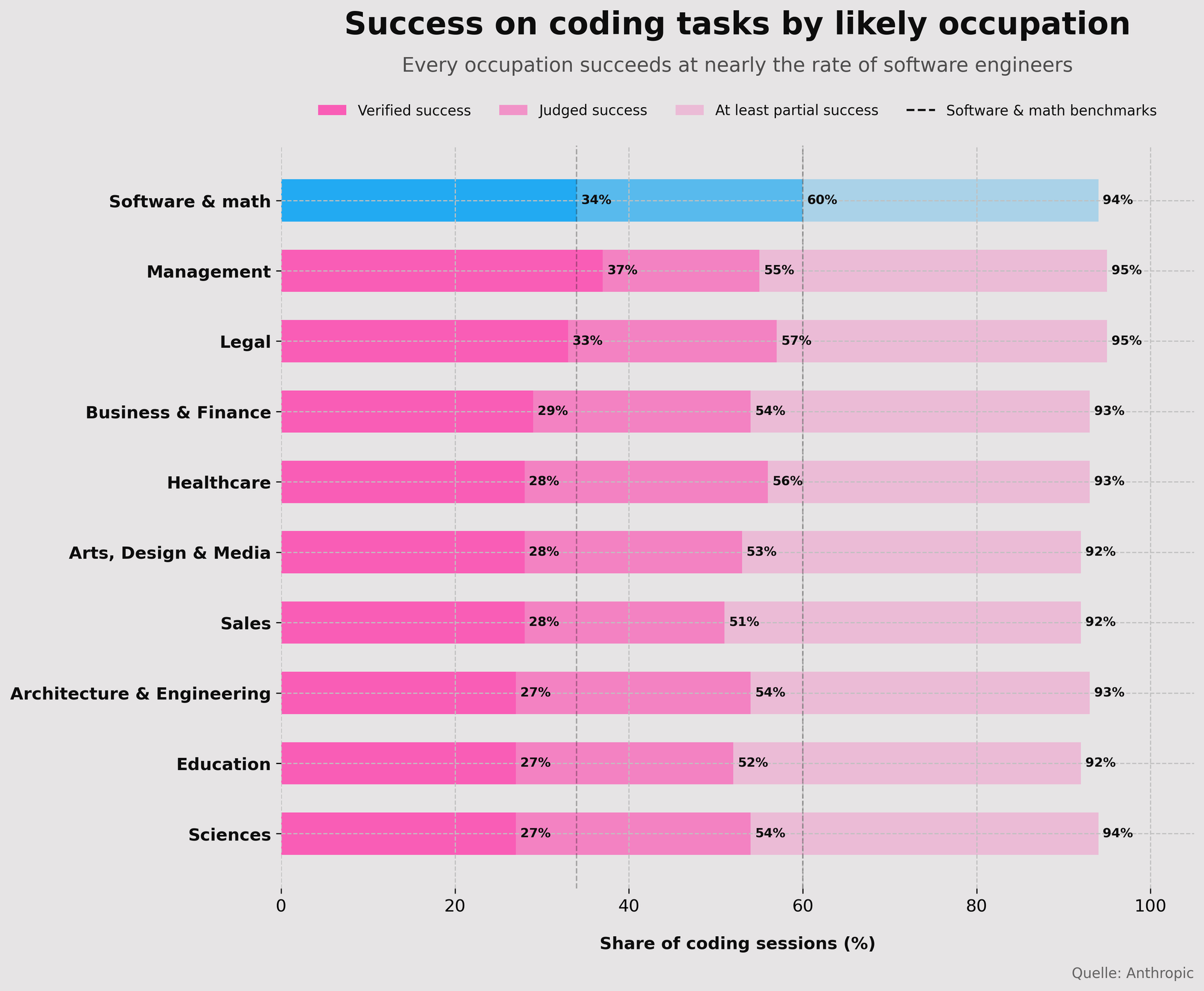
Sound absurd? It isn’t, though, once you understand why. Researchers explain this phenomenon with a remarkable transfer effect: Those who have learned to successfully lead human teams are also better at leading AI agents. While software professionals often tend to get lost in technical details or micromanage the code, managers do what they do best: they delegate as equals, formulate crystal-clear requirements, and consistently demand quality. So, in this case, a classic leadership skill trumps purely technical coding skills.
It would be easy to jump to the obvious conclusion: domain knowledge trumps technical coding skills. But behind this lie two very different effects that should not be confused. The first is the leadership effect just described: Those who have learned to lead people apparently also lead AI agents well. (Something we at Leaders of AI are convinced of.)
The second effect is independent of this and even more revealing: It is not one’s job title or coding background that determines whether someone will be successful with an AI agent, but rather how well that person understands the specific task at hand. An accountant who has never programmed but knows exactly which validation rules a script must follow will perform this task like an expert, whereas an experienced software developer with no knowledge of accounting will perform like a beginner. It is this task-specific competence that counts, not the job title on a business card.
Anyone who focuses solely on one of these two effects at this point overlooks the fundamental shift that is shaking the very core of our working world. What’s at stake here is something much more profound than the question of who is better at using a keyboard and code syntax.
What the study really shows: The division of labor is shifting
The real sensation of the study lies not in the success rates, but in the radical shift in the division of labor between humans and machines. The data reveal a clear pattern: In a typical session, humans make about 70 percent of the planning decisions—that is, deciding what needs to be done. AI, on the other hand, handles a full 80 percent of the operational execution—that is, determining how the task is actually carried out. (Source: Anthropic)
These figures mark a historic turning point. When purely technical tasks—such as writing, designing, calculating, and error-free translation—are almost completely automated, only one form of human contribution remains of value: judgment. When the agent autonomously handles the entire implementation, the human role consists solely of setting the exact direction in advance and evaluating afterward whether the result is even worth anything. The more the execution is automated, the greater the weight of human judgment.
The Digital Dunning-Kruger Effect: Why Non-Experts Fail Without Realizing It
It is precisely at this point that many users stumble headlong into a psychological trap: the digital Dunning-Kruger effect. This phenomenon describes the tendency of laypeople to drastically overestimate their own abilities—and, above all, the quality of the results they produce—simply because they lack the expertise to even notice their mistakes.
Today, an AI agent formulates its responses so eloquently, designs its graphics so flawlessly, and presents its calculations so professionally that a user unfamiliar with the subject matter trusts it blindly. The user applauds enthusiastically at the first visually appealing draft, overlooking fatal logical errors in the process. A brilliantly packaged mediocrity is mistaken for a masterpiece. Experts, on the other hand, distinguish themselves by their ability to realistically assess the limits of the agent and those of their own field of expertise. They know exactly where the weaknesses lie and critically validate the output.
The researchers’ figures on dropout rates (source: Anthropic study, 2026) demonstrate that this lack of judgment leads to a high frustration threshold in practice. When a technical problem or logical error occurs and the agent gets stuck, absolute beginners give up in frustration in a whopping 19 percent of cases and abandon the project entirely. They give up because, lacking technical knowledge, they cannot pinpoint the cause of the error. In contrast, for users with solid domain expertise, this dropout rate is a negligible 5 to 7 percent. They understand the technical rules of the game and can correct the agent with precision. Those who don’t realize why they’re stuck in a dead end will inevitably give up.
The Practice at Leaders of AI
Here at Leaders of AI, we experience this new division of labor every day. In our hybrid organization, ten people work closely with over 50 highly specialized AI agents. Our guiding principle is this: Each of our team leads hires the agents for their own area and manages them independently. One of these agents is Mira, our sales strategist, who creates outstanding dashboards and pipeline analyses.
So when our co-founder Dominic asks Mira to build a dashboard for our sales figures, she delivers a visually flawless overviewin just a few moments. He would be satisfied with that, but as soon as Philipp, CFO of Leaders of AI, reviews the dashboard, the entire framework of interpretation shifts. It takes Philipp just two seconds to see that the weighting of the lead sources is set up incorrectly and that the conversion rate is based on a flawed logical formula.

The difference here isn’t that Philipp is more skilled at using the tool or better at prompting it. The difference lies in the fact that Philipp possesses a deep understanding of excellent financial and sales strategies , honed over many years . This professional judgment serves as the true check and balance. Without this discerning eye, we would end up presenting nothing more than flashily packaged deceptions. It is only through Philipp’s expert guidance that a nice draft becomes a genuine, strategic tool.
The Shrinking Window of Opportunity: Why Prompting Is on the Way Out and Speed Is Key
This realization has taken on an enormous sense of urgency due to the breathtaking pace of technological advancement. We are currently experiencing a fundamental shift in the way we interact with artificial intelligence. Just a few months ago, we were still working with traditional chatbots. That meant constant, step-by-step control: a person would type a prompt, wait a few seconds, make corrections, and then type the next sentence.
Today, we are moving at a rapid pace toward truly autonomous agents that work in the background for hours on end, independently writing programs, analyzing databases, and delivering finished reports. As the renowned tech thought leader Ethan Mollick describes in his analyses, this is reducing our direct involvement in the process to nearly zero (Source: Ethan Mollick, 2026). Humans are almost completely removed from the process during execution.
Conversely, this means that the quality of the human contribution hinges heavily on two crucial moments. It is determined right at the beginning during the briefing—that is, when the strategic direction is defined—and right at the end during the critical review of the final result.
AI expert Mollick therefore advises us to make a radical shift in perspective: Anyone who wants to work successfully with agents must stop thinking of themselves as a technical operator. Instead, one must learn to see oneself as a true manager (Source: Ethan Mollick, 2026). Just as with a human team, one must take on the role of the conductor. However, anyone who cannot read the score will be elegantly and imperceptibly led by the nose by their own autonomously operating agents. The window of opportunity to acquire this deep discernment is narrow, and the half-life of superficial, half-baked knowledge is shrinking by the day.
What this means in practice
Mollick is not alone in this assessment. The Upwork Research Institute also reaches the same conclusion in its Future Workforce Index 2026 and gives this new role a name: the“AI Orchestrator.” This refers to a professional who combines AI tools with their own domain expertise, applies human judgment, and translates that into concrete business results. Research Director Jennifer Brett sums up the implication: The more AI agents become widespread, the more valuable this very skill—the ability to manage and integrate agents across complex workflows and take responsibility for them— will become (Source: Upwork Future Workforce Index, 2026).
Two independent sources, one conclusion:
It’s notthe speed of the prompting that matters, but the judgment one brings to the role of conductor.
3-Step Test
This raises a very practical question for executives and Self-employed individuals : How can you actually tell whether your team—or you yourself—has the necessary judgment to use an AI agent effectively in a specific field?
To answer this question without having to learn the hard way, you can use a simple three-step test. Answer the following questions for yourself and your employees:
- 1. The authority to approve: Can the person in charge who delegates the task to the agent verify the delivered result for technical and logical accuracy without outside help, or must they blindly trust the AI’s calculations?
- 2. Error Handling Proficiency: Is the user able to provide the agent with precise, technical guidance when an error message appears, or is he or she among the 19 percent who, frustrated, abandon the project at the first technical hurdle?
- 3. The standard definition: Does the person in charge know exactly what an excellent, industry-leading result looks like for this specific task, or are they satisfied with the first brilliantly designed draft?
If you can't answer these questions with a clear "yes" for a planned application, you shouldn't let the agent loose there. Otherwise, you'll just end up with expensive, undetected rejects.
Conclusion and Outlook
Let’s be clear: Your hard-earned expertise will not be replaced by artificial intelligence. Quite the contrary: The demands on the depth of this knowledge are increasing dramatically. Those who master only the day-to-day operational tasks will become replaceable. However, those who possess sharp, expert judgment will become indispensable shapers of the new world of work.
This is precisely where our programs at Leaders of AIcome in. Neither the Master Business with AI (MBAI®) certification nor the AI Integration Expert program are traditional technical courses. Rather, they are strategic tools designed to help you translate your existing domain knowledge into sharp, AI-driven judgment.
Anyone who wants to conduct successfully must be able to interpret the score masterfully. It is time to refine this judgment.
Additional Sources and References
- Original study: Hitzig et al. (2026): “Agentic coding and persistent returns to expertise, ” published on June 16, 2026. Direct link to the Anthropic study
- Academic reference: Ethan Mollick (2026): “The Twilight of the Chatbots, ” published on One Useful Thing. Direct link to the analysis
- Further reading: Upwork Research Institute (2026): “Future Workforce Index 2026,” published in July 2026. Direct link to the Upwork Future Workforce Index
- Photo of a laptop in Luca Bravo 's office on Unsplash