
Singapore is doing everything right. So why is the AI transformation stalling?

Singapore is offering grants of up to $2,000 for AI training. Still, transformation is difficult. Here’s what that means for your AI strategy.
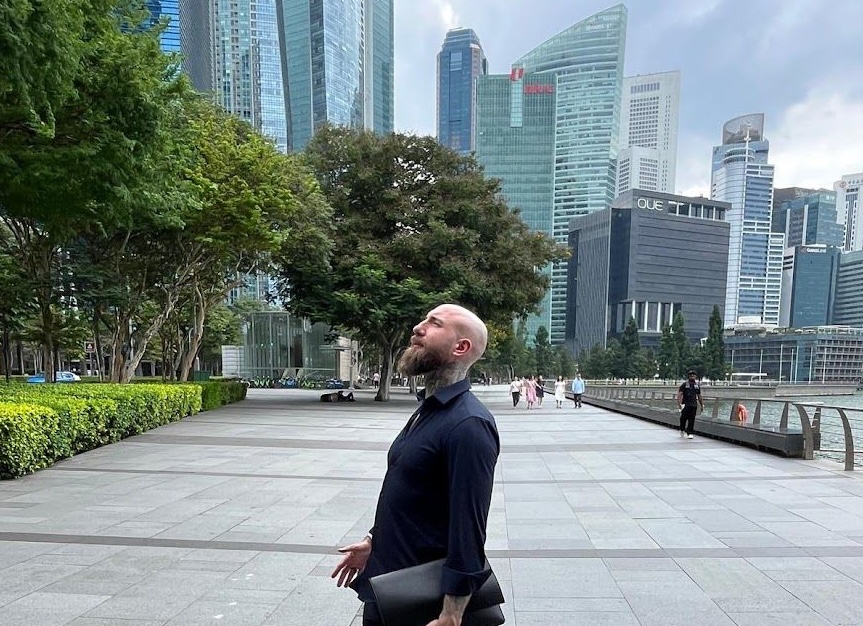
Dominic was recently in Singapore. Not as a tourist, but with a keen eye for what’s currently happening there. He gave three presentations on AI: a keynote speech, a presentation at the German Accelerator Startup Roundtable, and discussions with companies such as Mann+Hummel, Adidas, KSB, and Porsche.

The first impression upon arrival: AI is everywhere. Not just as a buzzword on conference banners, but in everyday life. Facial recognition at the border. Automated processes that would still be considered pilot projects in Germany. A cityscape that makes it clear: someone here has decided that this is no longer an experiment.
That's impressive. Really.
But then come the conversations. With entrepreneurs, with managers, with people who are in the midst of transformation. And suddenly it all sounds familiar. Employees aren’t on board. The processes are unclear. Managers don’t know where to start. The technology is there. The adaptation isn’t.
Was it worth flying out there just for that? Absolutely. Here's what Dominic brought back.
(Note: The following observations are based on Dominic’s personal impressions and conversations he had while there. They do not constitute a representative study.)
AI transformation is challenging on every continent
Singapore has something that Germany does not (yet) have: a government framework that actively accelerates the adoption of AI. The SkillsFuture program provides up to 2,000 Singapore dollars in funding for AI training for citizens. Companies receive tax incentives when they invest in AI training. The government has defined AI not as an option, but as a strategic necessity.
The results are clear. According to a study by Google , Singapore is one of the most digitized markets in Southeast Asia. The infrastructure is in place. The political direction is clear.
And yet: Companies are struggling.
This is not a criticism of Singapore. It is the real insight here. Because if even a country with government support, a clear strategy, and visible AI infrastructure struggles with the human side of the transformation in everyday life, then that is not a local problem. That is simply the nature of the matter.
In Germany, Bitkom: The percentage of companies using AI has risen from 15% (2022) to 34% (2024). Growth, yes. But 66% are not yet on board. And of those who are, very few have truly integrated AI into their core processes.
The pattern is the same everywhere: The technology is ready. People aren't yet.
What Singapore Shows, and What Lies Behind It
The difference between Singapore and Germany isn't the technology. Nor is it a lack of will. It's the speed at which the framework conditions evolve.
Singapore has treated AI as an infrastructure issue, not as a project-specific issue. That is a fundamental difference. When the government says, “We’ll subsidize your training with $2,000,” it lowers the barrier to entry. When companies receive tax incentives, it changes the budget logic. When AI is visible in everyday life—at the border, in public spaces, in government—it normalizes the technology.
That's impressive. And it's educational.
But it doesn’t solve the actual problem. Because behind all the government regulations, you can see just how difficult it is for people to adapt. Dominic’s observation on the ground: The reservations are different from those in Germany, but they’re there. In Germany, skepticism about data protection dominates. In Singapore, it’s more about hallucinations, reliability, and what AI can and cannot actually do. Different starting points, the same fundamental question: Can I trust this technology?
And this is precisely where the real challenge of the transformation lies. Not the infrastructure. Not the budget. But the person who opens their laptop tomorrow morning and decides whether or not to use AI.
5 Takeaways from Singapore
1. Government funding accelerates progress, but it does not replace it. Singapore demonstrates what is possible when a government treats AI as a strategic priority. Up to $2,000 in funding per person for AI training is not a pilot project—it is infrastructure. But even that does not change the fact that transformation begins in the mind. Funding lowers the barrier to entry. It does not remove it.
2. Normalizing visibility. When AI becomes visible in everyday life—at the border, in government, in public spaces—it ceases to be abstract. This is an underestimated lever. Companies that make AI visible internally—not as a hidden IT project, but as part of the daily work routine—reduce their employees’ reservations more quickly than any training program.
3. Concerns exist everywhere, but they vary. In Germany: data protection. In Singapore: delusions and reliability. Both are legitimate concerns. Both are solvable issues. But if you don’t know what your employees’ concerns are, you can’t address them. Transformation begins with listening, not with rolling out changes.
4. Transformation isn’t a technology problem. That’s the uncomfortable truth that Singapore confirms. Anyone who believes that better tools or a bigger budget will solve the transformation problem is in for a disappointment. What’s missing is almost always the same: clear processes, explicit quality requirements, and people who understand why they should use AI—not just how.
5. Education is the key driver. Singapore has recognized this and incorporated it into government policy. The question for business leaders in Germany is: Do I wait for the government to address this? Or do I invest now in my team’s AI expertise? The companies that do this today will have an insurmountable lead tomorrow.
Tomorrow is human. In Singapore, too.
Singapore is impressive. The infrastructure, the government’s ambition, the visibility of AI in everyday life. This isn’t just hype; it’s a strategy in action.

But the real insight is something else: Transformation is difficult on every continent. Not because of the technology . But because of the people. And that’s not bad news. That’s the most important message.
Because it means this: The key factor isn’t the next tool. It’s training. Expertise. The ability to lead AI, not just use it. Anyone who understands this has grasped the essence of the transformation.
Singapore provides a subsidy of $2,000 per person. What's your next step?
That is precisely the approach behind the Master Business with AI MBAI): No tool training. No theory. Instead, the expertise to strategically manage AI, design processes, and guide your team through the transformation. University-certified, proven in practice, with over 3,000 graduates from 25% of all DAX-listed companies.
If you know that education is the key to success, then the next step is clear.
Sources
- SkillsFuture Singapore: SkillsFuture Grant Scheme for AI Training
- Google, Temasek & Bain: e-Conomy SEA 2024: Riding the Digital Wave (2024)
- Bitkom e.V.: Companies are adopting AI – the proportion is rising from 15% to 34% (2024)