
Why is everyone talking about Claude right now?


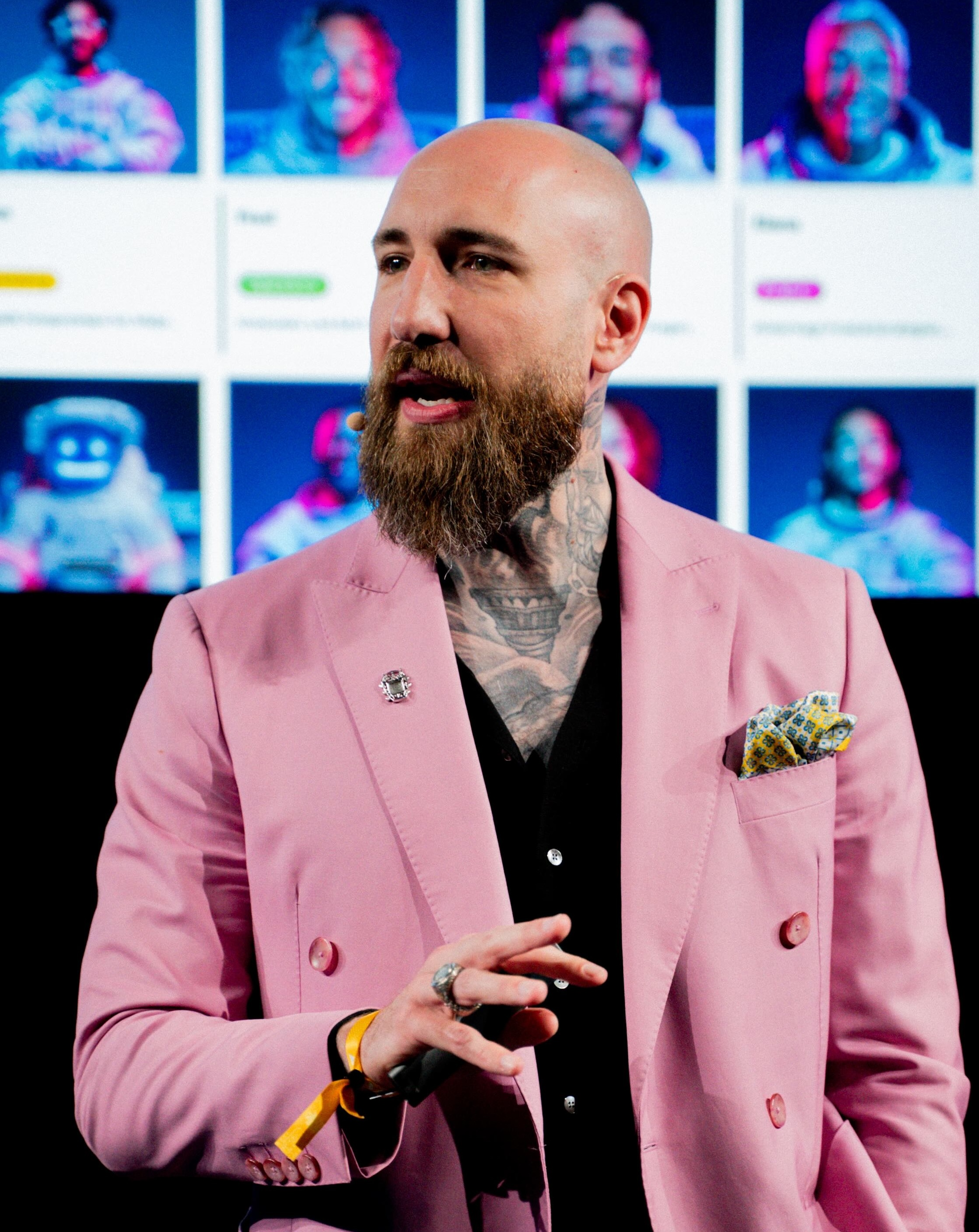
One idea stood out in particular at the OMR:
Agentic AI is here. AI is evolving from a tool to a team member.
In other words, no longer just a chat window that spits out text on command, but systems that prepare and prioritize tasks, think proactively, and integrate seamlessly into real workflows.
That's exactly why everyone is talking about Claude right now.
The hype isn’t just the next AI fad. It’s a sign. For the first time, many people feel that use cases—which for a long time seemed like a distant dream—are within reach: an assistant that can process large volumes of documents at once, prepare tasks, connect systems, and build things—all while seeming not just to respond, but to truly collaborate.
And that is exactly why now is a good time to do two things at once: take progress seriously while still remaining strategic.
What makes Claude so special right now
Claude is Anthropic's AI assistant. And the reason it's generating so much buzz right now isn't just because of the branding, but because of three major advancements that are immediately noticeable in everyday life.
Understanding: More Context, Better Decisions
While many AI tools eventually lose track when texts, files, or histories become too long, Claude can process large amounts of context in a single pass. Anthropic strongly emphasizes this capability in its descriptions of its models and product features. For users, this means, above all, that Claude can process large amounts of context in a single pass without requiring them to constantly break down the information into smaller chunks.
That sounds technical. In everyday life, it’s extremely practical.
Imagine you’re handed an 80-page contract and asked to identify the biggest risks. Or suppose you want to pinpoint the three most important pending decisions from several board presentations, email threads, and meeting minutes. Instead of breaking the content down into small chunks, you can input everything at once and work with a specific research question.
Then there’s Extended Thinking: Some questions don’t need a quick answer, but a better one. When you’re weighing pricing options, preparing a strategy document, or drafting a decision memo for senior management, the first plausible answer often isn’t very helpful. AI becomes valuable when it weighs options in a structured way, highlights counterarguments, and provides a more rigorous rationale.
Building: From Response System to Work Assistant
With features like Claude Cowork, AI is becoming not just a response system, but a work assistant—something that prepares, summarizes, prioritizes, and helps plan tasks. This is exactly the trend CNBC describes in a report on Claude Cowork.
In the past, the request was often: “Write me a report.” Now it’s more like: “Prepare for this meeting.” “Summarize these reports for me.” “Pull out the key points from this information.”
"Artifacts" takes this a step further: Claude doesn’t just provide text, but directly usable results. Small calculators, interactive dashboards, checklists, visual overviews. If you need an ROI calculator or a quick visualization of quarterly figures, it’s generated directly as a usable object. This turns the AI not just into a writer, but into a co-creator.
ServiceNow, in collaboration with Anthropic, reports that sales teams using Claude spent 95 percent less time preparing for client meetings. Of course, figures like these should always be taken with a grain of salt. But they highlight the key point: it’s not about producing nicer-sounding text, but about transforming workflows.
Connecting: AI in a Real-World Work Context
With MCP and other integrations, AI no longer sits in isolation alongside your tools; instead, it can access and work with information from systems such as CRMs, databases, or Drive folders. For many, this is precisely where the real progress lies: AI no longer merely sits alongside existing tools, but is moving closer to real-world work environments and data flows.
Instead of copying data manually, just ask: Which deals are closing this month? Which projects have the most outstanding risks? Where do these three documents conflict?
Added to this is the safety promise. Anthropic strongly positions Claude around "Safety by Design," as demonstrated by research papers such as "Constitutional Classifiers " and "Constitutional Classifiers++." For companies that work with confidential data and sensitive processes, this is no minor detail. Trust in the system’s behavior becomes a key issue as soon as AI is deeply integrated into workflows.
Why the hype is justified, but there’s no need to rush into migration
All of that is impressive. Really.
And that is exactly why it would be wrong to pretend that Claude is just another overhyped gimmick. The progress is real.
But the next instinctive reaction would be just as wrong: that we now have to switch everything over to Claude.
By 2025, we had completely transitioned our programs to European tools. That was a massive investment. And that’s exactly why we wouldn’t throw it all away today just because one provider is currently making the most visible leap in quality.
After all, we’ve seen this pattern before. It was the case with GPT-4. It was the case with reasoning models. And it will most likely be the case here as well: what looks like a clear lead today will become the standard in many areas faster than the hype suggests.
That is why, at Leaders of AI, we don't teach tool loyalty—we teach principles.
Our 50+ AI assistants run on any platform. System prompts and memory are stored in separate databases. A reporting assistant can run on Langdock today and on Claude, GPT, or Gemini tomorrow. Only the connection changes.
In our view, that is precisely the difference between being driven by hype and being strategic. The key question isn’t: Which tool is currently leading the pack? It’s: What capabilities do you need in the long term, and on what architecture do you want to build them?
Why the real management question is now called organizational design
The more powerful AI becomes, the clearer a second point becomes: The problem isn't just about choosing the right tools. The problem is organizational design.
AI does not work effectively in companies simply by giving it as much autonomy as possible. It works effectively when roles, responsibilities, handoffs, and escalation procedures are clearly defined.
That is precisely the point behind the topic of “micromanaging AI.” The real question isn’t whether AI assistants are coming. The real question is how organizations need to be structured so that they can work with them effectively.
Who manages whom? Where does decision-making authority lie? How many direct reports can an AI system handle? Where do silos form? When is escalation necessary?
These aren't peripheral issues. These are architectural issues.
At Leaders of AI, we therefore view AI systems not as a loose collection of tools, but as an organizational structure. In our programs, we conduct empirical research on precisely these issues: where setups break down, where they hold up, and how many interfaces an AI system can handle before it becomes unreliable.
So when Claude demonstrates just how powerful AI can be as a work assistant, it doesn’t diminish a second truth—it actually highlights it: the more powerful these systems become, the more important leadership becomes.
Why the concept of polarization is important here
At this point, a third issue also comes into play; while it may seem like a tangent at first glance, it is directly relevant to the topic.
Social media rewards sensationalism. Strong opinions. Quick reactions. Clear-cut sides.
As AI becomes more deeply integrated into actual knowledge work and decision-making, the more interesting question isn’t just which tool can do more. The more interesting question is whether these systems also help us think more effectively.
This is precisely where the first indication becomes intriguing: various AI systems could steer people away from extreme positions and toward more moderate, fact-based viewpoints. An initial indication of this can be found in a report by the Financial Times.
That doesn't mean AI is neutral. Nor does it mean that AI automatically makes things objective.
But this aligns very well with what we’ve observed in our own content work: When we use AI to develop topics, opposing viewpoints become apparent more quickly, assumptions become clearer, and arguments become more robust.
That is why, for us, AI is not just a production tool. It is also a thinking tool.
And that is exactly what belongs in the same article as Claude’s: because real progress isn’t just about AI taking on more tasks. It’s also about how AI can transform the quality of preparation, reasoning, and decision-making.
Bottom line: Claude is important, but what you make of it is even more important

Claude isn't relevant right now simply because one provider has "won."
Claude is significant because it demonstrates how AI is maturing: more context, more autonomy, and greater integration into real-world work.
The hype is justified. But justified hype doesn't make for a strategy.
Those who focus solely on the loudest tool will jump restlessly from one trend to the next. Those who, on the other hand, think in terms of architecture, roles, prompt design, integrations, and decision-making quality build something far more valuable: systems that will survive the next shift.
And that is precisely the core management task at this stage of AI.
Sources
- CNBC: Anthropic Claude Cowork – Office Worker
- Anthropic: ServiceNow & Anthropic – Claude
- Gmelius: Claude AI vs. ChatGPT
- arXiv: Constitutional Classifiers
- arXiv: Constitutional Classifiers++
- Gurusup: Claude vs. ChatGPT – A Comprehensive 2026 Comparison
- Financial Times: AI and Polarization