Will AI replace me?
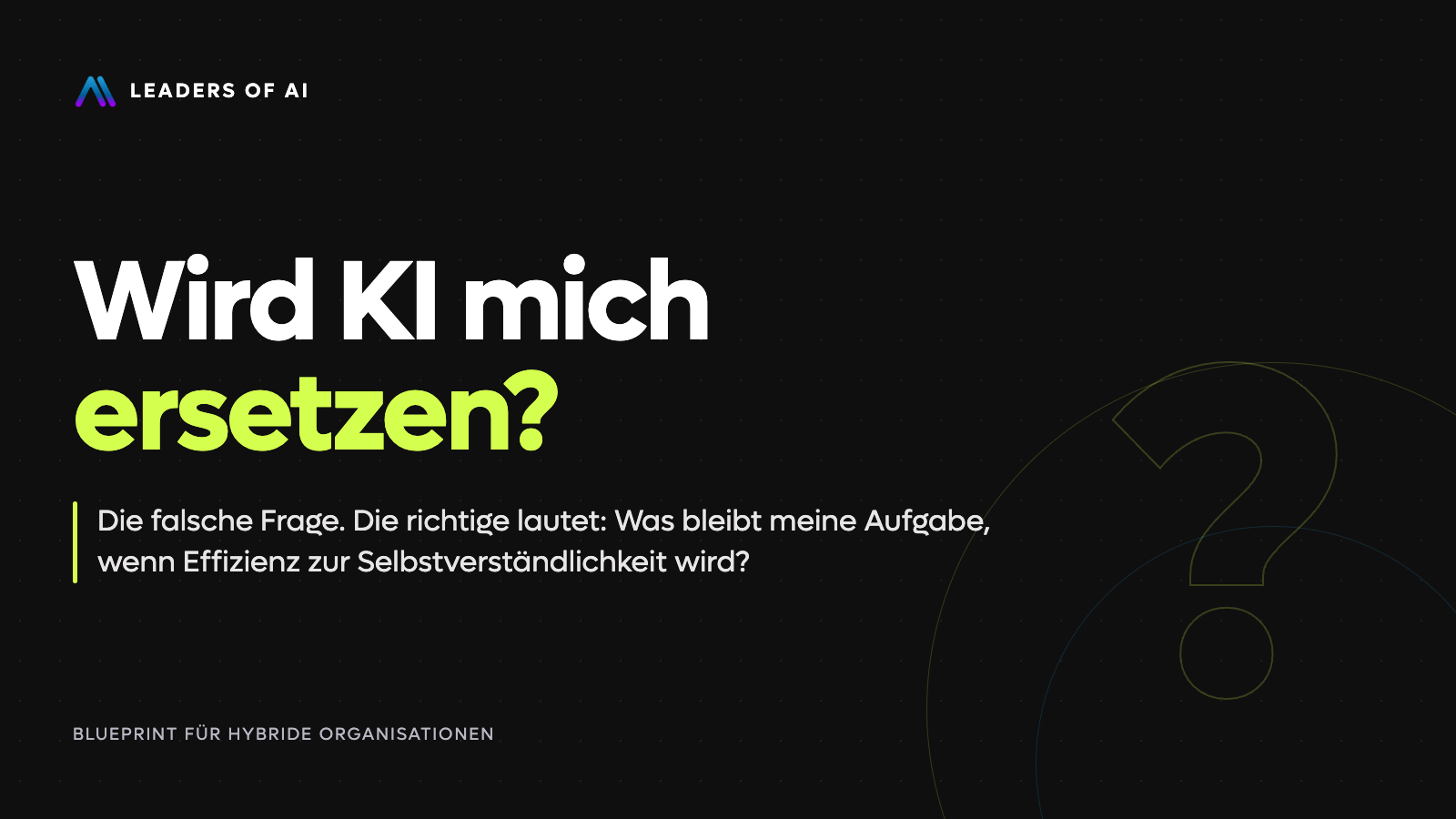
In July 2026, Dominic von Proeck (founder and CEO of Leaders of AI) and Prof. Lukas Zenk (professor of innovation and network research) published a 62-page document: the Blueprint for Hybrid Organizations. In it, they analyze three years of real-world experience at Leaders of AI, including all decisions, missteps, and solutions. The document is divided into six “nuggets,” each of which sheds light on a key aspect of hybrid organizations. In this series, we’re translating the insights from the Blueprint into concise, practical articles for your day-to-day work. Today, we’re focusing on perhaps the most personal of these nuggets: the role of humans as machines become increasingly capable.
What to expect: An honest answer to the question that’s on every workforce’s mind right now—without sugarcoating it, but also without causing panic. We’ll show you which three skills will remain with people in the long term, why symbiosis yields better results than pure automation, and what that means for your own role in the company.
This article answers the following questions:
- Will I be replaced by AI, or just the work I do now?
- Why is efficiency becoming commonplace as more and more companies adopt a hybrid work model?
- How do I answer the question, “What actually makes me irreplaceable?” without getting caught up in a race against AI that I can’t win?
- What skills will truly matter in the future, when technical proficiency becomes less important?
Is it worth reading on if you work with AI agents yourself or if your organization is becoming more hybrid? Yes, because the answer to “Will AI replace me?” will help determine whether you shape the next wave or get swept away by it.
When Dominic introduced the AI agent Jürgen (who handles marketing at Leaders of AI) to a group of executives, one of the CEOs in the audience offered only a dry remark: “The ladies in my marketing department wouldn’t be enjoying this meeting right now.” The reaction is human and understandable, yet it misses the real point. After all, anyone who defines themselves by a purely operational role (e.g., “I’m the marketing director; I write the copy”) seems to lose their own identity along with that task. The answer, however, does not lie in clinging to the old role. It lies in asking a more precise question.
A contradiction that isn't really a contradiction
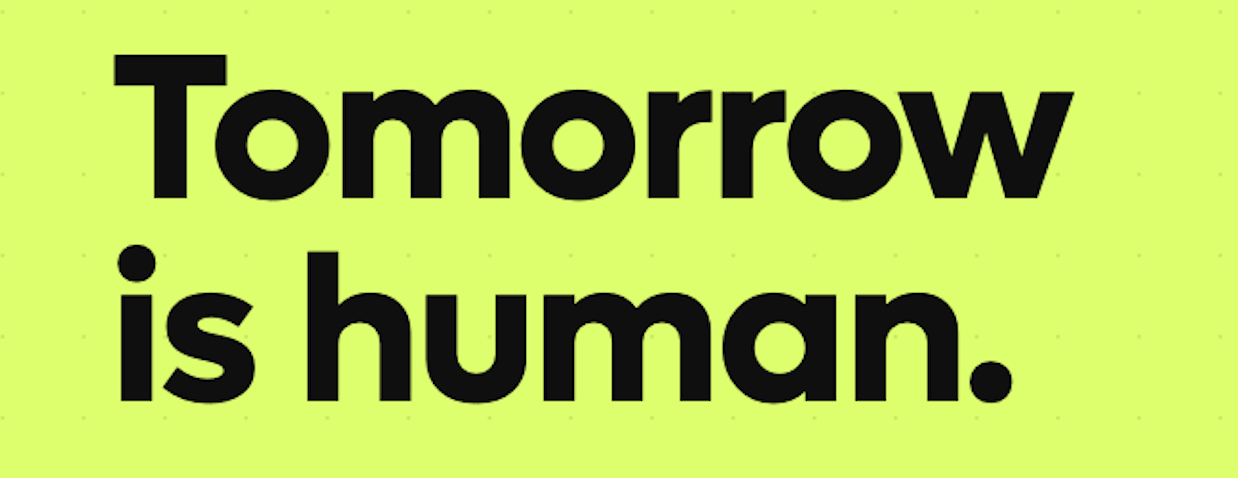
Leaders of AI is one of the most efficient educational organizations on the market. Ten people and over fifty AI agents deployed productively generate a profit margin considered unparalleled in the industry. And yet—or perhaps precisely because of this—our motto is: Tomorrow is human.
That’s not a contradiction. It’s a bet on the next wave, similar to discounting in the financial world: just as markets already factor future developments into today’s prices, we anticipate values that won’t become scarce—and thus valuable —until several years from now.
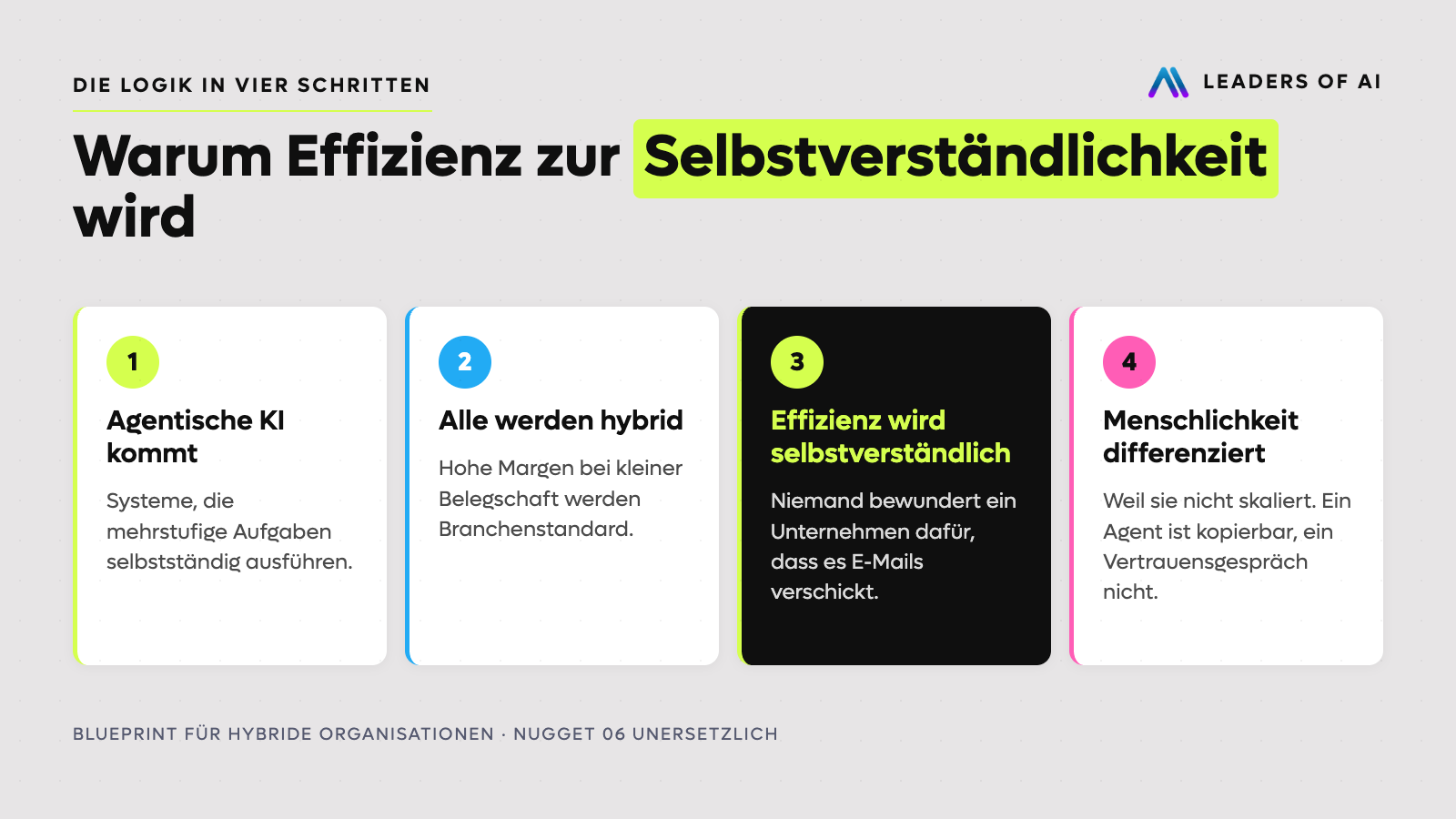
The logic behind this can be broken down into four steps.
- The next wave is agent-based AI—that is, systems that independently perform multi-step tasks.
- In just a few years, most companies will be using such systems, and hybrid, automated processes, agent-based teams, and high margins with a small workforce will become the industry standard.
- This makes efficiency commonplace. No one admires a company today for sending emails. Tomorrow, no one will admire a company for using AI agents.
- When everyone works in a hybrid model, the question arises anew: What distinguishes one hybrid organization from another?
Our answer: humanity. And for a rather pragmatic, structural reason: it doesn’t scale. An agent can be replicated a thousand times. A trusting conversation cannot. That is precisely why, in a world of unlimited scalability, what cannot be scaled becomes a scarce resource.
We’re familiar with this pattern from other markets. As long as almost all clothing is produced in factories, “handmade” is a premium signal; artisanal production derives its value precisely from the perfection of the mass production that surrounds it. Initial data points in a similar direction: According to eMarketer, the percentage of consumers in the U.S. and the U.K. who view AI-generated content critically rose from 18 percent (2023) to 32 percent (2025). In a Goldman Sachs survey, 54 percent of Gen Z respondents stated that they do not prefer AI involvement in creative work. And even we at Leaders of AI—a fully digital business model—are experiencing this at our own events: The more meetings move online, the greater the need for in-person interaction becomes. Digitalization apparently does not breed indifference toward the human element, but rather a counter-movement.
The Question of Identity: What Actually Makes Me Irreplaceable?
Many people answer the question of their own irreplaceability with a comparison: AI just isn’t as good at something as they are yet. This consolation is doubly fragile.
On the one hand, the systems continue to evolve, and much of what is still the domain of humans today may be handled better by machines tomorrow . On the other hand, the comparison is misleading because AI does not improve at a uniform rate.
Since the 1980s, the so-called Moravec paradox has described how machines fail precisely at tasks that humans consider trivial, while they solve tasks that humans consider difficult. Models can prove mathematical theorems at the Olympiad level, yet for a long time they were unable to draw an analog clock showing a time other than ten to two.
Anyone who bases their sense of irreplaceability on a point-by-point comparison with AI is therefore building on shifting ground—in both directions.
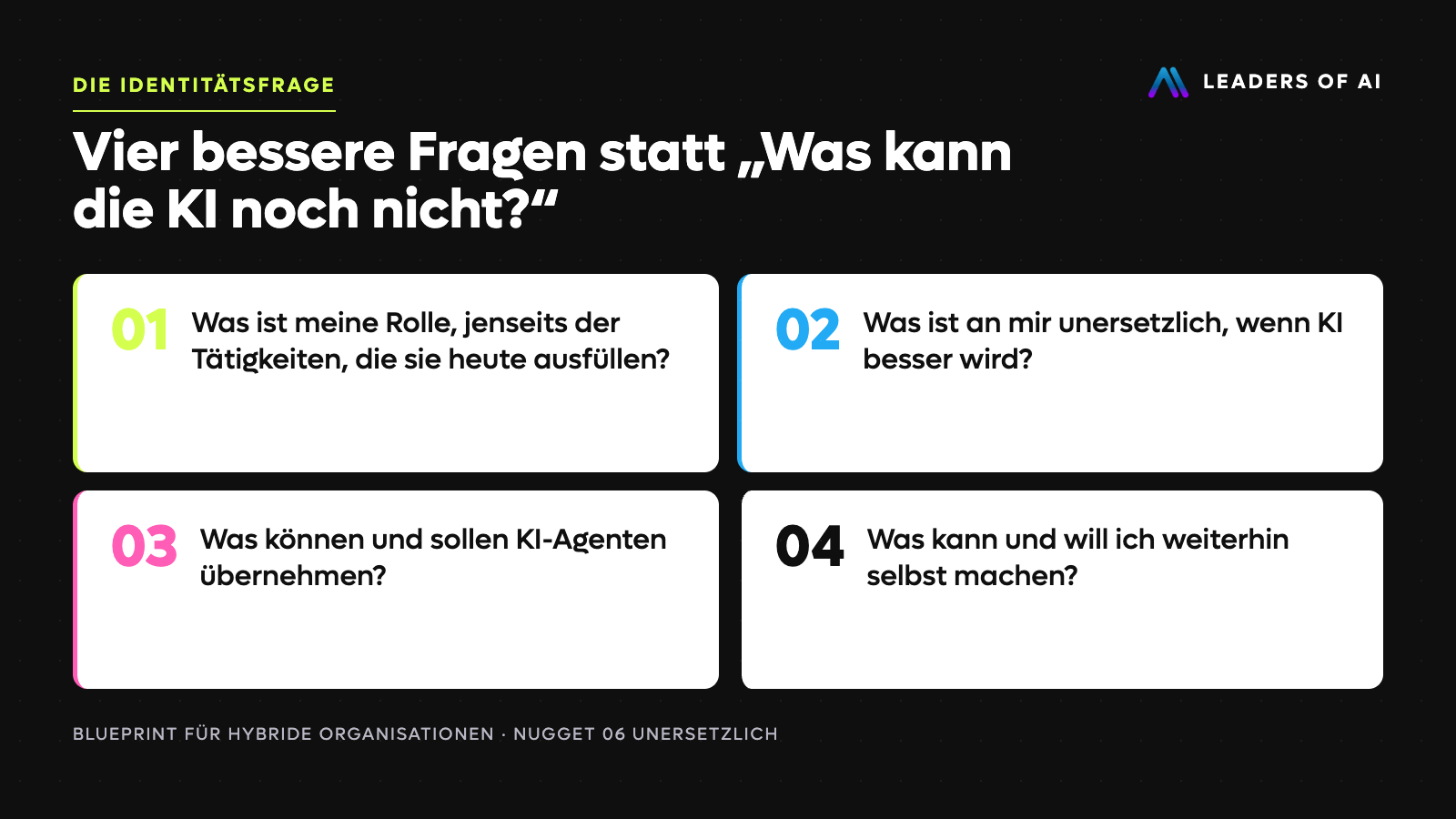
A more productive way to frame the question consists of four subquestions:
- What is my role, beyond the tasks I currently perform?
- What makes me irreplaceable as AI gets better?
- What tasks can and should AI agents take on?
- What can I still do on my own, and what do I want to continue doing myself?
These questions require a level of self-awareness that was rarely explicitly required in traditional organizations, where colleagues would tacitly fill in the gaps.
In hybrid organizations, this lack of clarity comes at a high cost: Anyone who wants to use agents must explicitly decide what to delegate and what to deliberately not delegate. The marketing director from the example isn’t just a copywriter. She knows the company, its culture, and its customers; she assesses which tone is appropriate and which is harmful—and it is precisely this experience that serves as a guiding principle for an agency team that handles the operational work. Her role shifts from writing to taking responsibility for what is written.
From Technical Expertise to Leadership Skills
In the early 1990s, Linus Torvalds, the creator of Linux, gave his computer science students in Helsinki a week to complete the task of sending him an email, because back then, you first had to set up a mail server to do so.
The use of AI agents is currently in precisely this experimental phase: It is still considered the domain of specialists, but in a few years it will be the norm in nearly every profession.
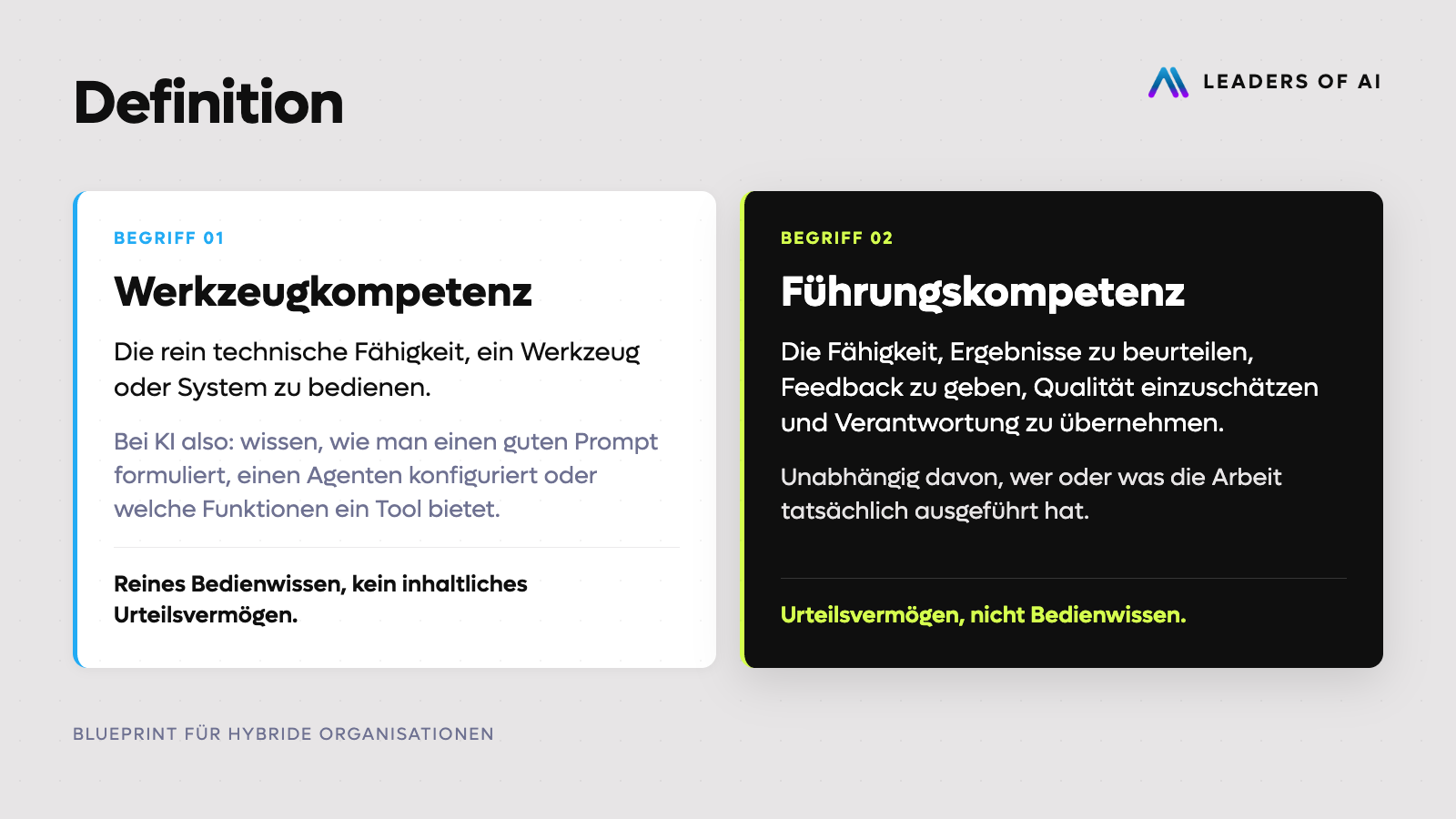
What matters most, then, is not so much technical proficiency as leadership and learning skills: giving instructions, assessing quality, providing feedback, and constantly adapting.
The World Economic Forum’s “Future of Jobs” report confirms this: 39 percent of today’s skills will change or become obsolete by 2030. At the top of the list of in-demand skills are analytical thinking, resilience, leadership, and creative thinking. It’s striking that not a single one of these is a technical skill.
Symbiosis Trumps Autonomy
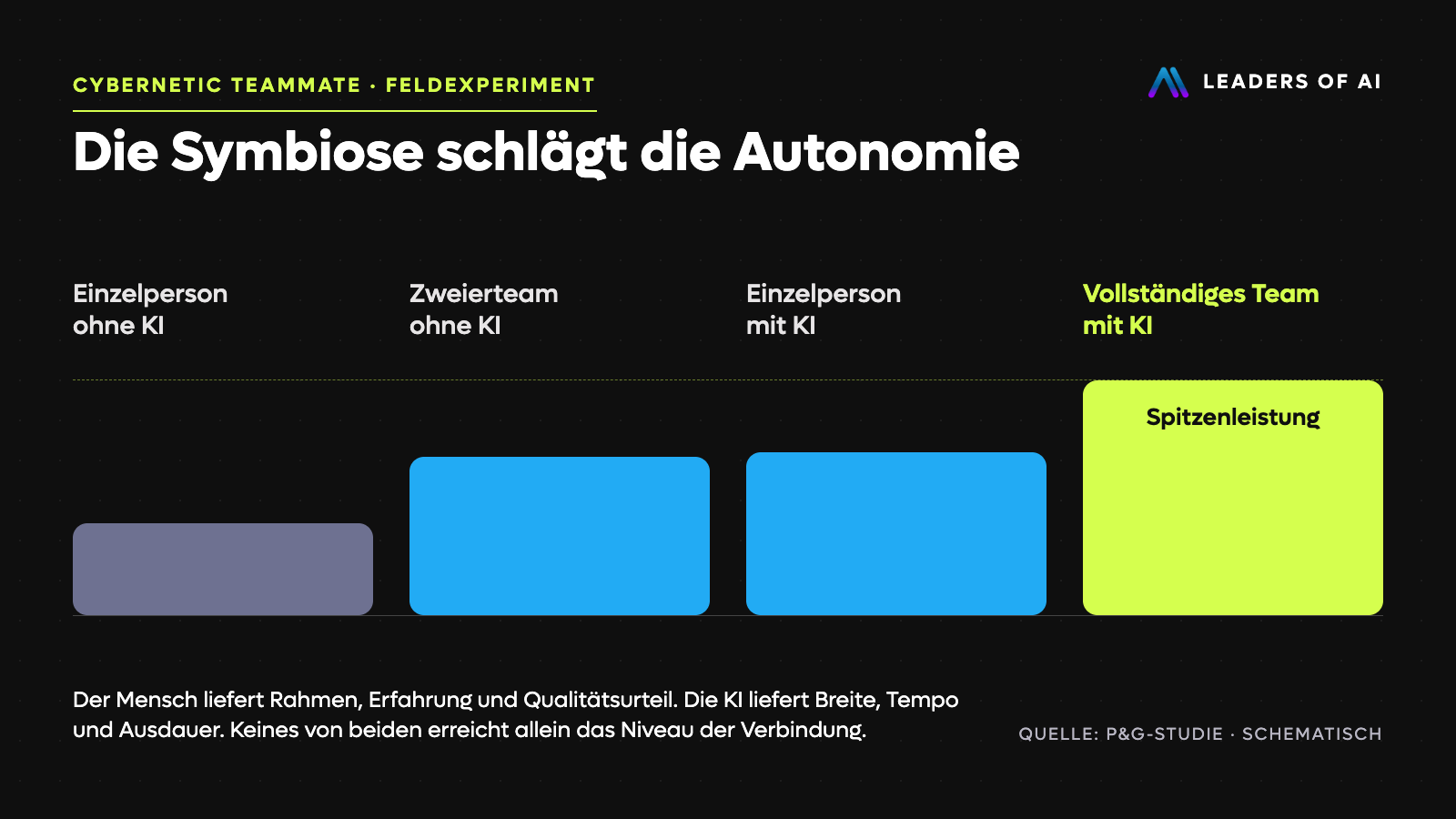
One key finding directly contradicts the logic of pure replacement: The highest quality is currently achieved through symbiosis, not autonomy. While the oft-cited field experiment onthe “Cybernetic Teammate” at Procter & Gamble showed that individuals using AI can match the performance of two-person teams without AI, the combination of a fully human team plus AI was found to yield peak performance.
We at Leaders of AI have had the same experience in our own daily lives. When Dominic and Prof. Lukas Zenk were working together to develop the first chapters of our Blueprint, Dominic remarked that Lukas’s expertise was what truly elevated AI to excellence. He himself couldn’t do it without Lukas, and neither could AI—even though the most powerful models available were being used.
The equation is not a simple addition, but rather a dynamic interplay: Humans provide the framework, experience, and judgment of quality; AI provides breadth, speed, and endurance. Neither can achieve the level of integration on its own.
Accordingly, it is not those who defend their jobs against AI who are irreplaceable, but rather those who master this symbiosis: the ability to contribute their own experiential knowledge in a way that allows machine performance to surpass it. Management research refers to this role asthe “Decision Architect”—someone who determines which steps the AI takes, where human judgment is incorporated, and how the two interlock. Those who master this role become more valuable—and irreplaceable—with every improvement in the models.
What AI Can't Do (Yet): Taste, Curation, Imperfection
In addition to areas that remain structurally human, there are abilities where the line is less clearly defined—though, to be honest, with the caveat“for now.”
These include taste—the intuitive decision based on accumulated experience—and curation—the experience-based selection from an abundance of options. It is wise to be wary of premature complacency: AI systems could very well become masters of curation; in some areas, they already are.
However, it remains a valid point that while the selection process itself can be automated, the determination of the selection criteria remains a matter of the framework—and, for the foreseeable future, it is people who decide on that framework.
The most robust category is a third one: imperfection. AI systems are systematically optimized to avoid errors and follow probabilities. The human impulse to defy probability—the irrational decision that a system based on cold calculations would never have arrived at—remains a domain uniquely human. Not because AI is too weak, but because it is optimized in the opposite direction. An organization benefits from a degree of productive irrationality: from decisions that, from a purely mathematical standpoint, are not the right ones—and yet, precisely for that reason, build relationships, open up markets, or foster trust.
Internally, we call this the “Spark”— the impulse that defies probability, for which there will be no good machine-based equivalent in the coming years. After all, a well-functioning irrational AI would be a contradiction in the objective function.
The artisanal analogy takes this further in economic terms: If every garment is sewn perfectly, the one with a slightly misaligned row of buttons gains value—that imperfection is proof of human craftsmanship.
Related: According to PwC’s AI Jobs Barometer, the professions most exposed to AI are adding human-centric skills—such as empathy, judgment, and creativity —to their job requirements 2.5 times faster than those least exposed. Machines are not displacing the human element from these professions; rather, they are concentrating it there.
So no one is being replaced?
This question naturally comes up most often in boardrooms, and the honest answer is more nuanced than some would like. The fear of widespread layoffs does not consistently hold up to empirical scrutiny: Growth-oriented companies tend to redirect freed-up capacity toward new value creation rather than eliminating it.
The owner of a global industry leader once summed it up for Dominic: It would never occur to him to lay anyone off; his biggest constraint had always been his focus—he could immediately keep every employee busy with meaningful work as soon as capacity became available. You can only cut costs down to zero; the potential for added value is unlimited.
In the Future of Jobs Report, 50 percent of employers say they want to move employees from shrinking roles to growing ones.
It is the role that is replaceable, not necessarily the person. But it would be disingenuous to infer a guarantee from this. Every transformation has its losers; demands will increase, and in highly standardized, process-driven areas, roles will disappear without being replaced. The honest message is not “no one will be replaced,” but rather: Those who actively shape this shift will be in a much better position than those who cling to their old jobs.
The Tree and Its Roots
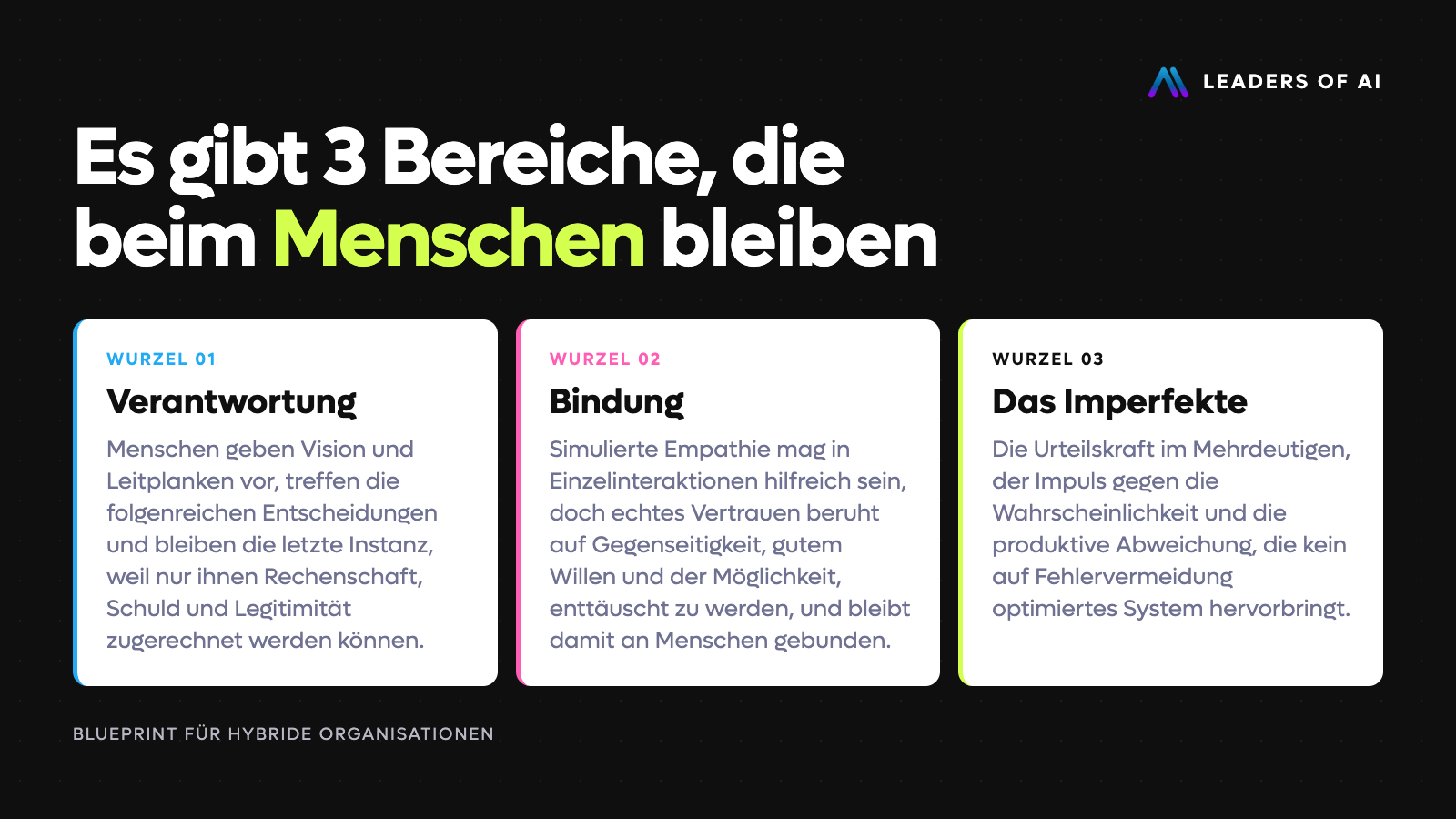
If we synthesize the practices of Leaders of AI and the current state of research, three areas remain that are inherently human:
Responsibility. People set the vision and guidelines, make the far-reaching decisions, and remain the final authority, because only they can be held accountable, blamed, or deemed legitimate.
Bond. Simulated empathy may be helpful in one-on-one interactions, but genuine trust is based on reciprocity, goodwill, and the possibility of being disappointed—and thus remains tied to human beings.
The Imperfect. The power of judgment in ambiguity, the impulse that defies probability, and the productive deviation that no system optimized for error avoidance can produce.
The research on this topic offers a warning: Those who delegate too much risk the erosion of precisely these skills. The research refers to this as “deskilling”—people who become passive rubber-stampers of AI suggestions rather than actively exercising their judgment. Irreplaceability, therefore, is not an inherent trait, but a skill that is maintained through use and lost through disuse.
This gives rise to the central metaphor of this topic: The taller a tree grows, the deeper its roots must go; otherwise, the first storm will knock it down. The more agent-driven the world of work becomes, the more human organizations and individuals should become—not as a counterpoint to technology, but as its stabilizing force.
And because roots don’t grow on their own, humanity must be actively fostered: in leadership culture, in the way interactions are structured, and in the conscious decision regarding which points of contact within an organization should remain human.
The implication for every leader: Stop asking what AI can do better than you. Ask what part of your job will remain once AI can do everything it’s already capable of today. The answer will determine whether you’ll still be needed in five years—or whether you’ll simply still be employed.
👉🏻 Do you think AI should enhance your work rather than replace you? Then our MBAI program is the right choice for you. Throughout the course, you’ll develop your own AI agents step by step for all relevant areas of your business. Upon completion, you’ll have a ready-to-go team that can immediately support you and your company—for example, in the executive office, HR, business development, marketing, and sales. You can find all the details here:
Sources
- Internal Sources: Blueprint for Hybrid Organizations (v1), Nugget 06 “Irreplaceable”
- External sources: eMarketer (2023/2025), Goldman Sachs (Gen Z study), WEF Future of Jobs Report, PwC AI Jobs Barometer, P&G Cybernetic Teammate study