
Are AI agents already outdated again?


Ever since Anthropic introduced Claude Cowork —a new approach for businesses—our phones have been ringing off the hook. This refers to an AI system that not only handles individual tasks but is also better able to plan and coordinate independently, control the computer, and do much more.
The question we've been asked time and again ever since: Are AI agents now obsolete? Should we even bother getting started with them at all?
What still seems like a debate within the AI bubble today already offers a hint as to where things might be headed. Behind it all lies a very specific management question: How should AI actually be structured within an organization? As a network of many specialized agents? As a centralized AI operating system? Or, at some point, as something entirely different?
This is precisely the question we at Leaders of AI have been exploring since January of this year.
Our perspective on this topic is never purely technological.
We aren't primarily interested in which tool sounds the smartest right now or which architecture looks the most elegant on a slide. What interests us most is this question: What is the best way to integrate AI into organizations?
Ultimately, an organization is not just a loose collection of tools. It has a purpose. It consists of roles, responsibilities, processes, collaboration, and decisions. Competitive advantage, therefore, does not automatically arise simply because the most powerful model is running somewhere. It only emerges when AI is embraced in everyday life, embedded in workflows, and measurably improves actual work.
So the question isn't: Which technology is the most powerful? Rather: Which form of AI can actually be integrated into companies in a way that produces results?
Why We've Relyed on Agents So Far
It is precisely from this perspective that we at Leaders of AI have focused on the agent-based approach so far.
At our company, every employee now has a personnel file, regular feedback sessions, and a refined personality profile. At first glance, that might sound like an HR team that’s a little too enthusiastic. The subtle difference: 53 of these files belong to AI agents. Of our 63 team members, only 10 are flesh and blood; the rest are AI agents.
It is an attempt to integrate AI into an organization in a way that makes it accessible to people—with clear roles, clear responsibilities, and a form of collaboration that not only works technically but is also tangible in everyday life.
Why We're Asking the Question Again Anyway
Then came Claude Cowork, and with it a debate that doesn't automatically disprove the path we've taken so far, but certainly challenges it.
At this point, we could have simply said: Our approach is set; we’ll continue as before. But that would have been too easy. The debate is shifting not only on LinkedIn but also in the research community. The current body of research is anything but clear-cut. Some studies support self-organizing agent models, while others argue more strongly in favor of centrally orchestrated enterprise architectures.
When it comes to AI in particular, we’re all still learning. That’s exactly why we didn’t want to turn the debate into a matter of faith. We wanted to take it seriously and deliberately test our current approach against a different one. We wanted to find out: Who wins—agents or the operating system?
Two paths, two religions?
To have a meaningful discussion, one must first understand that two very different ways of thinking are clashing here.
The Agent Approach: The Digital Organizational Chart
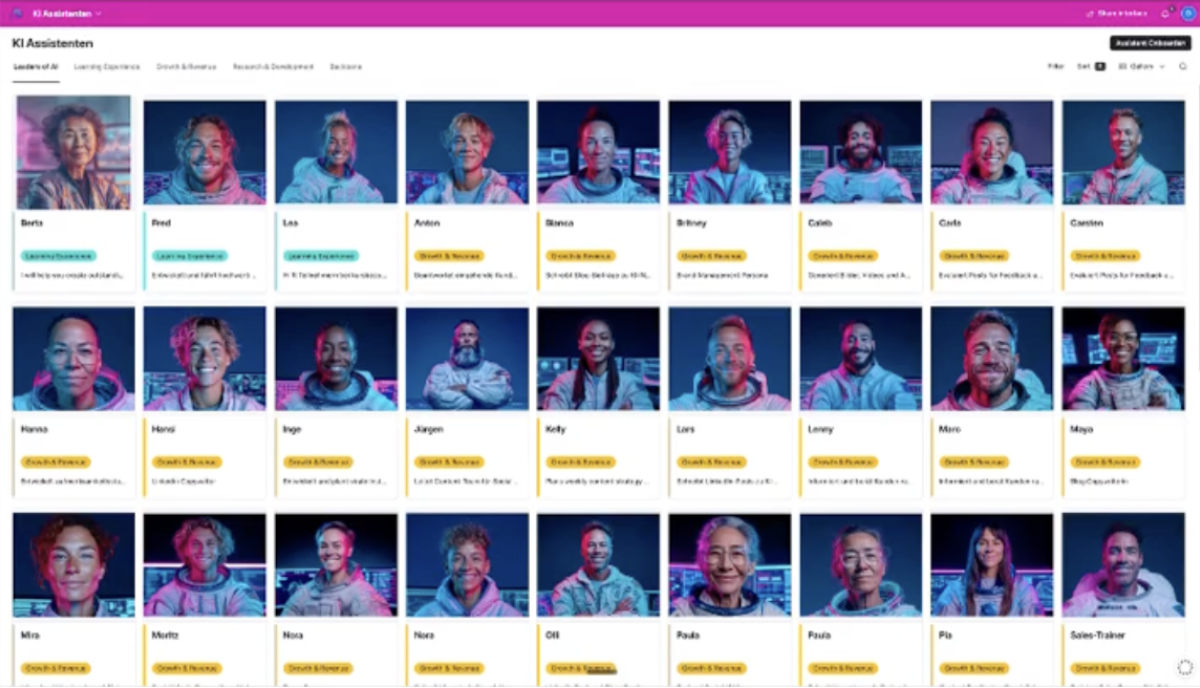
The agent-based approach essentially builds a digital replica of the actual organizational chart. There isn't a single, large AI running in the background; instead, there are many specialized agents with clear roles, tasks, and responsibilities.
At our company, for example, this includes Monika as a personal assistant, Helga in the recruitment of new AI employees, and Jürgen as a team leader in content marketing. The key point is that people build relationships with them and manage, provide feedback to, and help them grow just as they would with any other colleague or employee.
So the relationship with AI is a kind of interface. Those who work with this approach aren't managing an anonymous software system; rather, they're working alongside other team members.
The AI Operating System: A Centralized System with Access to Everything
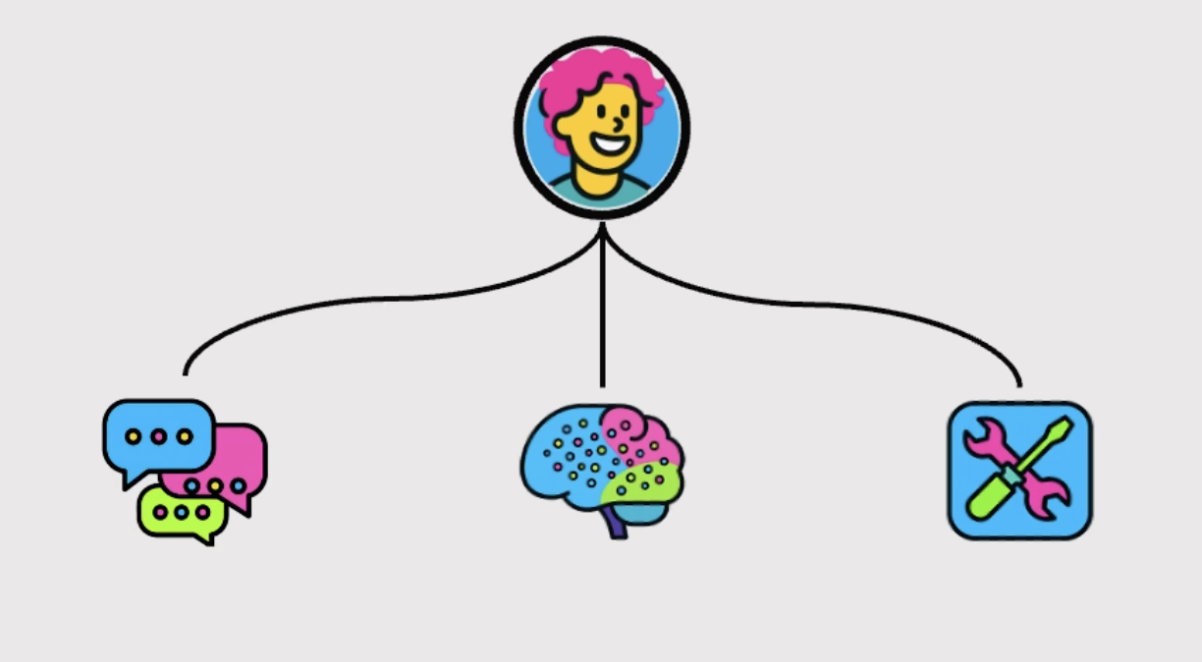
The AI operating system follows a completely different logic. It’s not about having many visible roles, but rather about a centralized system that can understand and utilize as much of the company’s operations as possible at the same time.
Instead of working with Monika, Helga, or Jürgen, there is a central entity—a kind of “super agent” or “operating system agent”—that can access all knowledge, tools, and databases. This agent uses predefined capabilities—such as retrieving data from a CRM, searching internal documents, updating a calendar, or triggering a follow-up process—and decides for itself which approach to take, depending on the task.
With an AI operating system, this visible role-based logic disappears. In its place comes the concept of centrally bundled intelligence, which can more easily transcend departmental boundaries and thus get the most out of AI models that are becoming increasingly intelligent.
How Our Self-Experiment Was Structured
The agent-based approach focuses on roles, responsibilities, and collaboration. The AI operating system focuses more on capabilities, access, and centralized orchestration. One makes the organization visible. The other abstracts it more deeply into a centralized system.
Both approaches can be useful. But they have very different implications for how people work with AI, how responsibility is allocated, and how trust is built.
Because we didn't want to discuss these differences merely in theory, we launched a deliberate self-experiment six months ago.
Together with Danube University Krems in Austria and Munich University of Applied Sciences, we have since been investigating what happens when AI agents collaborate directly with one another in the demanding day-to-day work environment. Our goal is to determine whether it is actually possible to assemble the mathematically optimal team of agents for different business cases.
At the same time, we have implemented a comprehensive AI operating system alongside our existing agent structure in order to observe the differences between the two approaches not only in theory but also in real-world work situations.
Our goal is not to get caught up in a LinkedIn "religious war," but to better understand what works in practice and how.
Agents vs. Operating System: Who Wins?
That is precisely what gives us the key question for the coming weeks: Who will win—the agents or the operating system?
A quick answer would be convenient, but not particularly helpful. After all, this isn't about two buzzwords from the AI bubble, but rather two very different ways companies can integrate AI into their day-to-day work.
That's why we're not turning this question into a quick thesis, but rather a series.
In the next few parts, we’ll first look at why so many companies—and we ourselves—started using agents in the first place. Then we’ll break down the AI operating system: the approach that’s currently getting so much attention because it seems more centralized, autonomous, and technologically powerful. And finally, we’ll draw an honest conclusion from our own experiment.
What This Is Really About
So the real question isn't which buzzword sounds more modern right now. The more important question is which form of AI collaboration actually works in organizations.
That is exactly what we want to explore in this series— not as a matter of belief, but as a practical question. What really works in everyday life? And why might the most exciting answer in the long run lie neither in a pure agent model nor in a pure operating system, but rather in fluid teams?
Next week, as the first step in our exploration of the agent-based approach, we’ll address its shortcomings—including its advantages, but above all the areas where it reaches its limits in practice.
Sources
- Victoria Dochkina, Moscow Institute of Physics and Technology, 2026: " Drop the Hierarchy and Roles: How Self-Organizing LLM Agents Outperform Designed Structures"
- Dutao Zhang, Liaotian, Macao Polytechnic University, 2026: Queen-Bee Agents: A BeeSpec-Centered Architecture for Governed Enterprise MCP Orchestration