
Do I have to be an AI expert to build agents?

Here at Leaders of AI, we’re naturally curious. Not just about the latest AI developments, current research, or exciting tools, but also about everything happening within our company. That’s exactly why we analyzed the data we collected in 2025/2026 and summarized the results for you. The goal wasn’t to prove that our programs work, but rather to test a hypothesis: namely, that people who use AI on a daily basis have an advantage when it comes to learning new AI skills and implementing AI agents. (And, logically, they also perform better in our programs.) And let’s just say: the results are surprising.
What you'll find in this article: Of course, the answer to the question in the title. Insights into why people take AI training courses, how long it takes to build your first agent with the help of Leaders of AI, the difference between AI usage and AI proficiency, and everything else our study revealed. Let's go!
Before the program began, 6,071 people assessed their own AI usage and proficiency . Over the course of four months, we then tracked what 2,835 participants actually did: what agents they built, what systems they connected to, and how they worked.
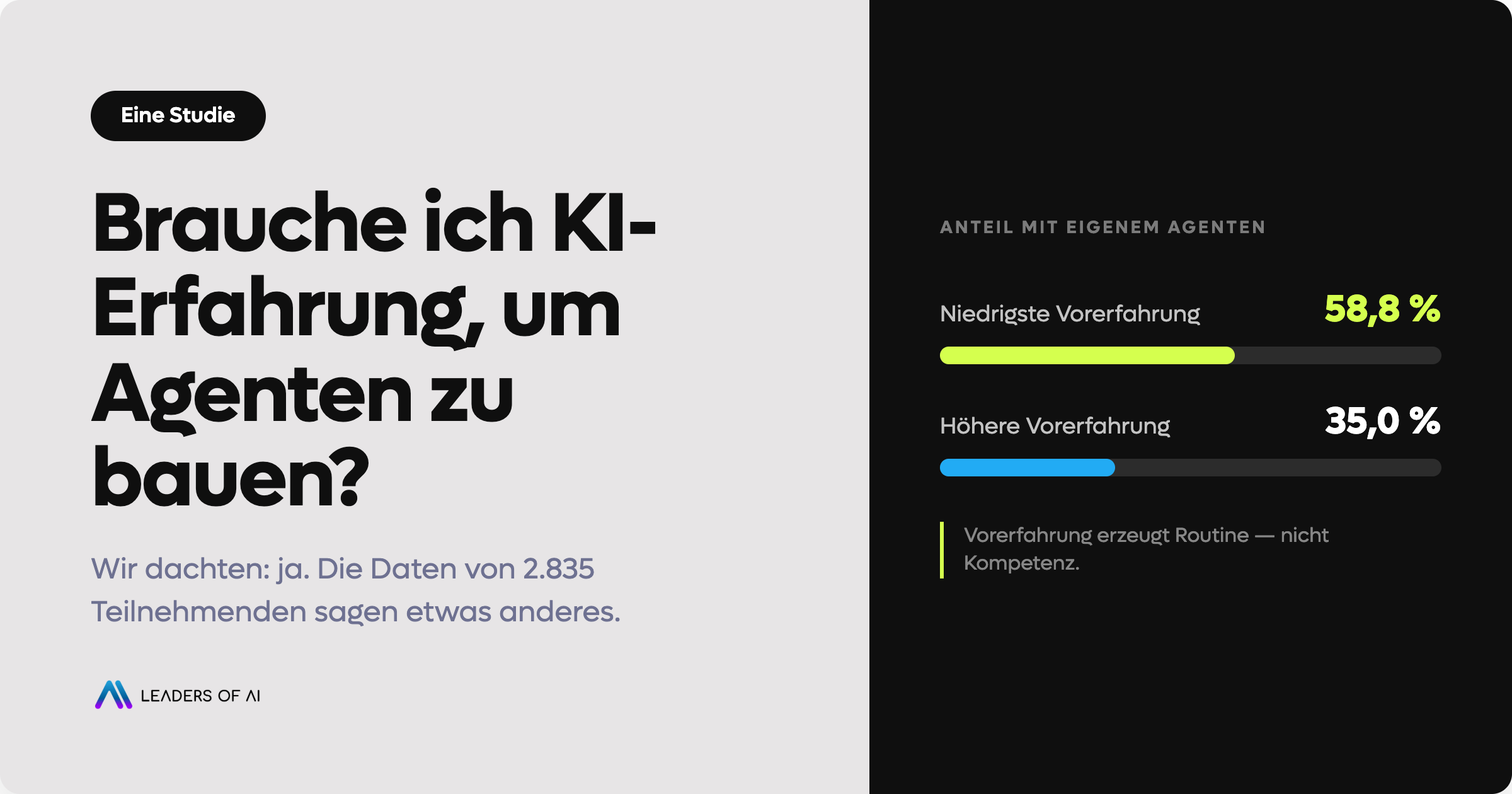
The results were clear. But they disproved our assumption: People with more prior experience with AI don't automatically get further. Sometimes they even make slower progress.
This contradicts everything we intuitively assume. And it explains why so many companies fail at AI transformation. Let's take a closer look.
Least prior experience, steepest learning curve: What our data shows
We have both data sources for seven company cohorts: the workforce’s self-assessment before the start and their actual behavior afterward. This allows us to see who started at what level and who ultimately built their own AI agent.
The result defies intuition.
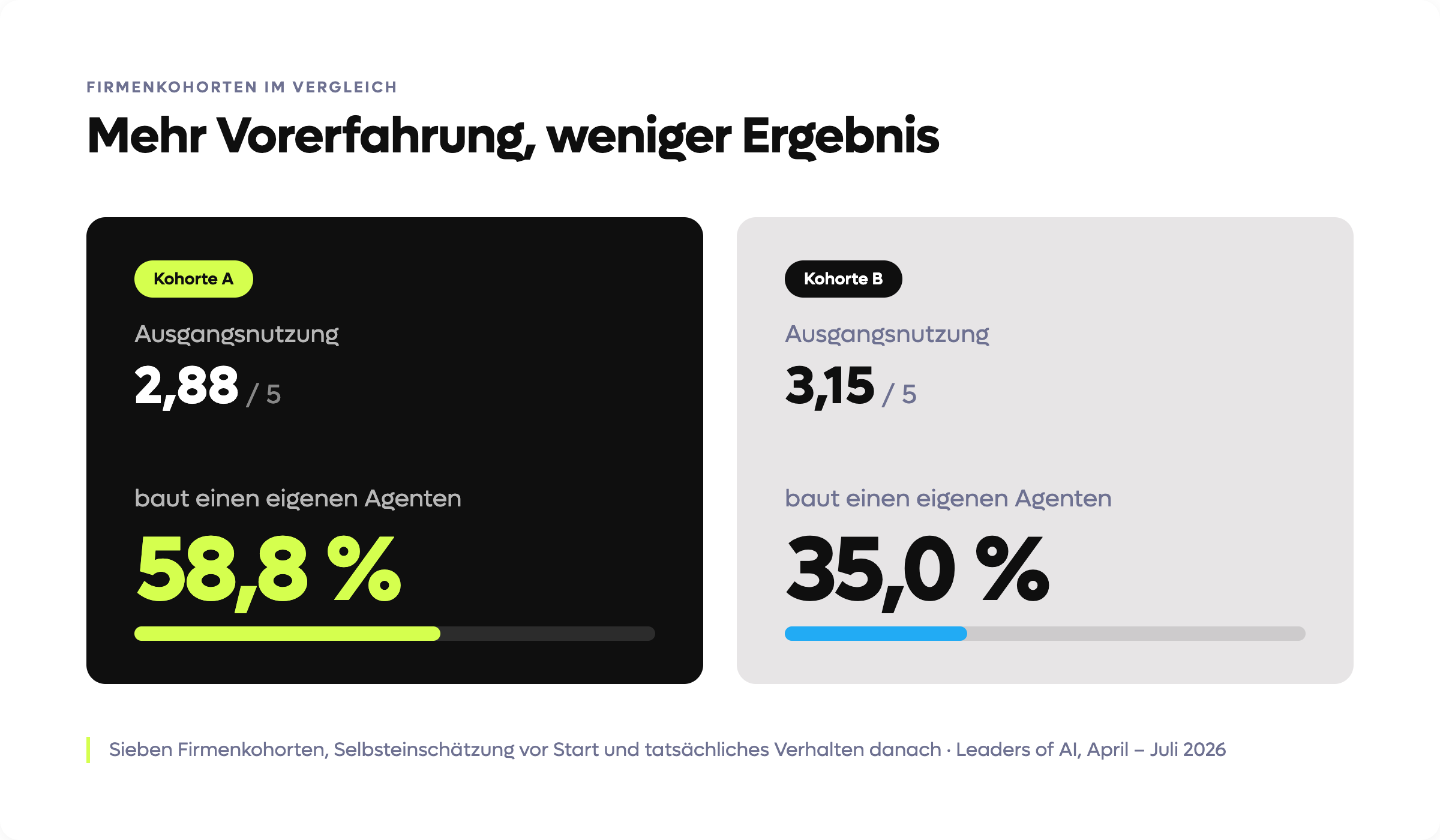
The cohort with the lowest baseline usage (2.88 out of 5) achieves an impressive 58.8 percent in construction proficiency. Another cohort with higher baseline usage (3.15), on the other hand, achieves only 35 percent.
So, those who have used it more in the past don't automatically get ahead. Previous experience isn't an advantage. Sometimes it's even a disadvantage because it creates a false sense of confidence.
The same pattern is evident when it comes to the initial level of proficiency: The company with the lowest initial proficiency in the field (2.16 out of 5) still directs 58.8 percent of its active participants to its own agent.
A low starting point is not a disqualifying factor. At most, it makes the journey longer.
Why Previous Experience Can Be a Problem
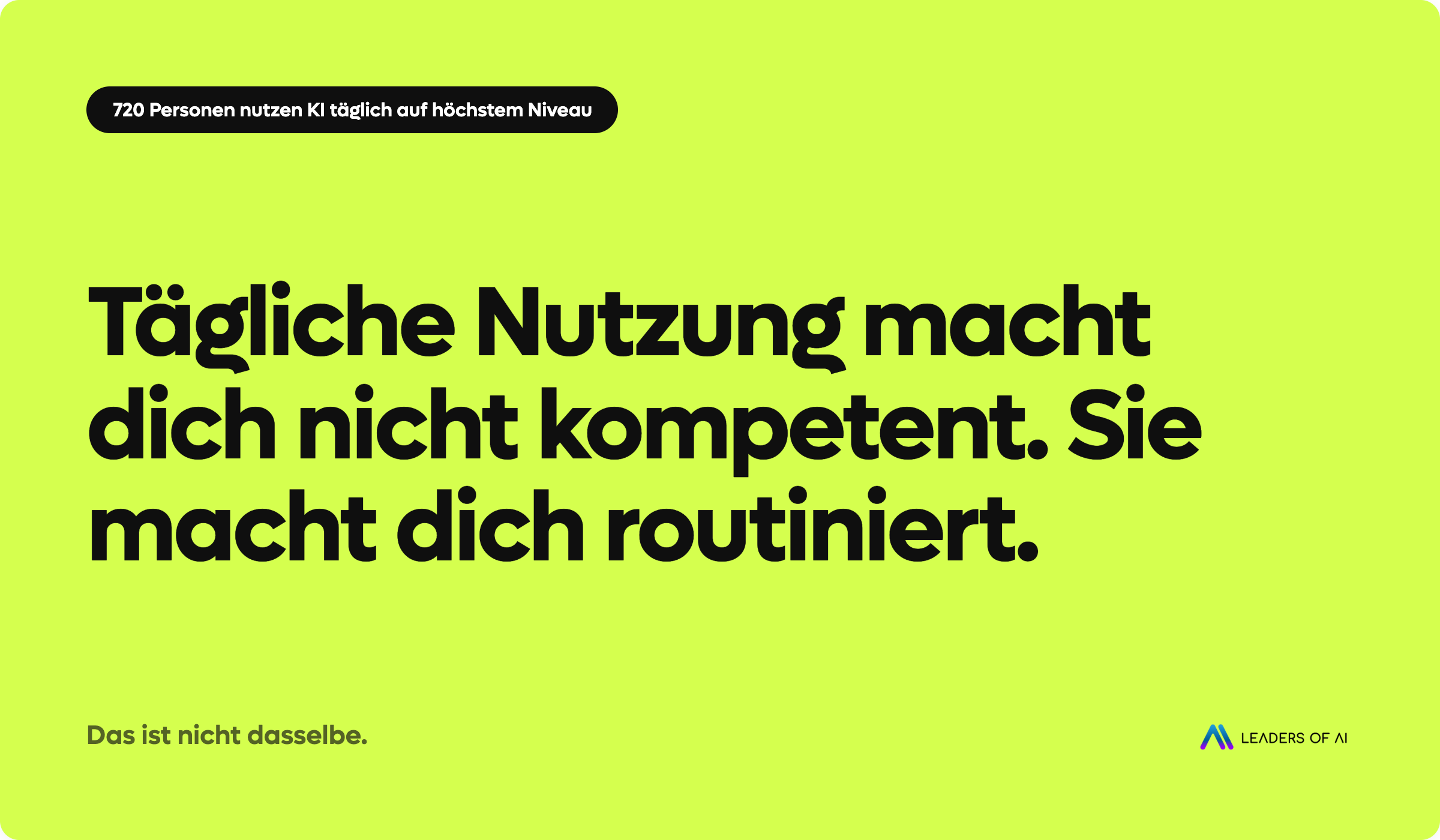
This pattern runs throughout the entire study. 720 people report using AI daily and at the highest level, yet still rate their proficiency as only average. Those who use it a lot still know very little.
And that’s exactly where the problem lies: People who are experienced often believe they’re competent. They’ve learned a few tricks, a few prompts that work. They get by in their day-to-day work. But they don’t understand what’s happening behind the scenes. They can’t tell when the AI is spouting nonsense. They don’t know how to make processes explicit enough for the AI to take them over. (Read more about this in our latest blog post.)
Previous experience creates a false sense of confidence. And a false sense of confidence prevents people from being willing to learn.
Beginners, on the other hand? They know that they don't know anything. They're willing to learn from the ground up. They ask questions. They question results. And that's exactly why they catch up faster.
Still, the speed is surprising.
But back to the numbers. Because as counterintuitive as the prior experience paradox is—the speed at which people catch up is even more surprising.
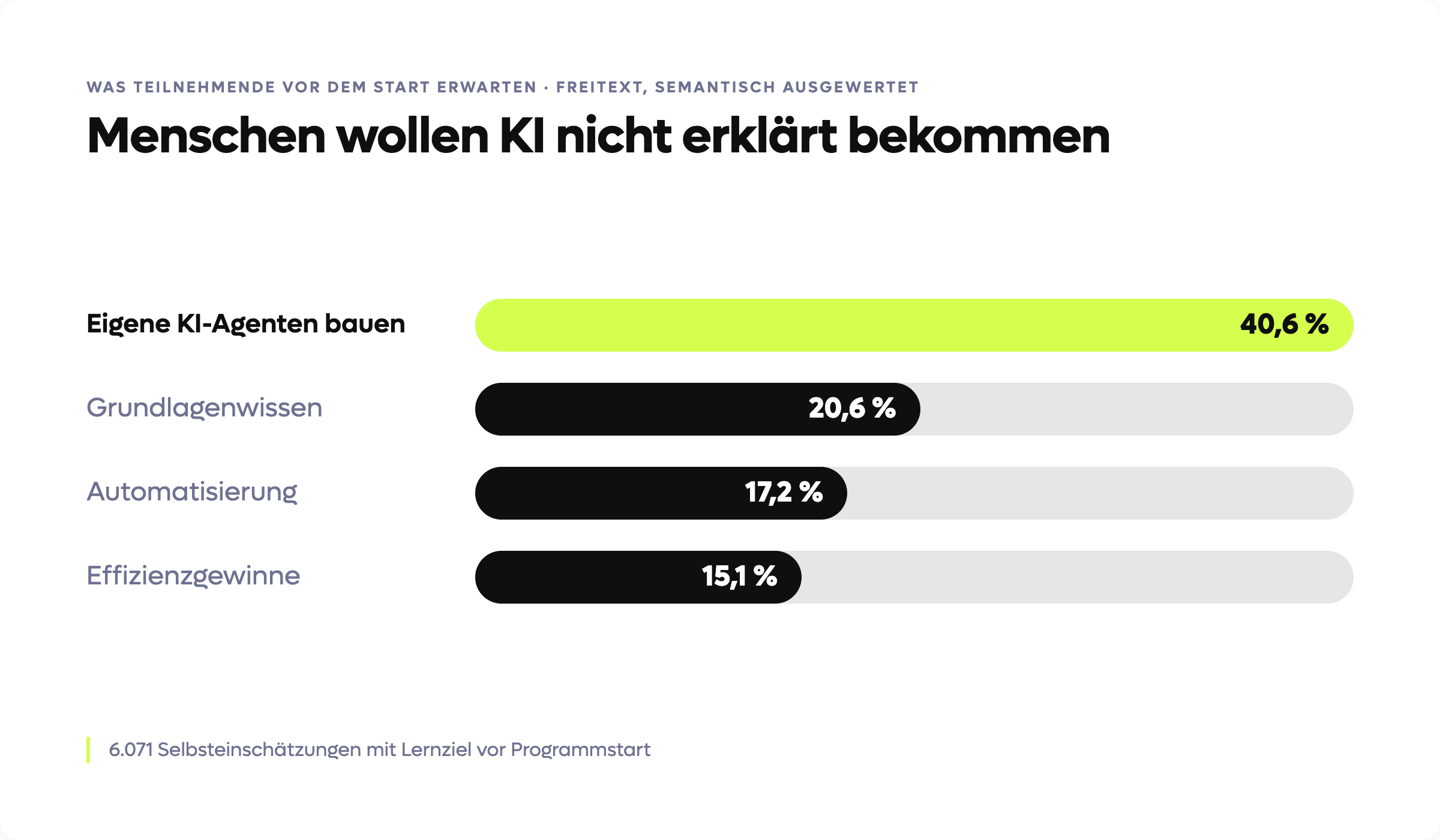
Before the program began, we also surveyed participants about their expectations regarding AI. The responses were open-ended and analyzed semantically. The result: At 40.6 percent, the desire to build their own AI agents is by far the most common motivation—well ahead of acquiring foundational knowledge (20.6 percent), automation (17.2 percent), and efficiency gains (15.1 percent).
People don't want AI explained to them. They want it to work for them.
And that’s exactly what happens: 79.3 percent of all active participants build their own AI agent. Not eventually, but quickly: 86 . 4 percent of them do so within their first active month in a Leaders of AI program, and 97.6 percent by the following month. And yes, we were particularly pleased with these figures. Because what was previously described as a long-term goal has become routine after just four weeks of guided work.
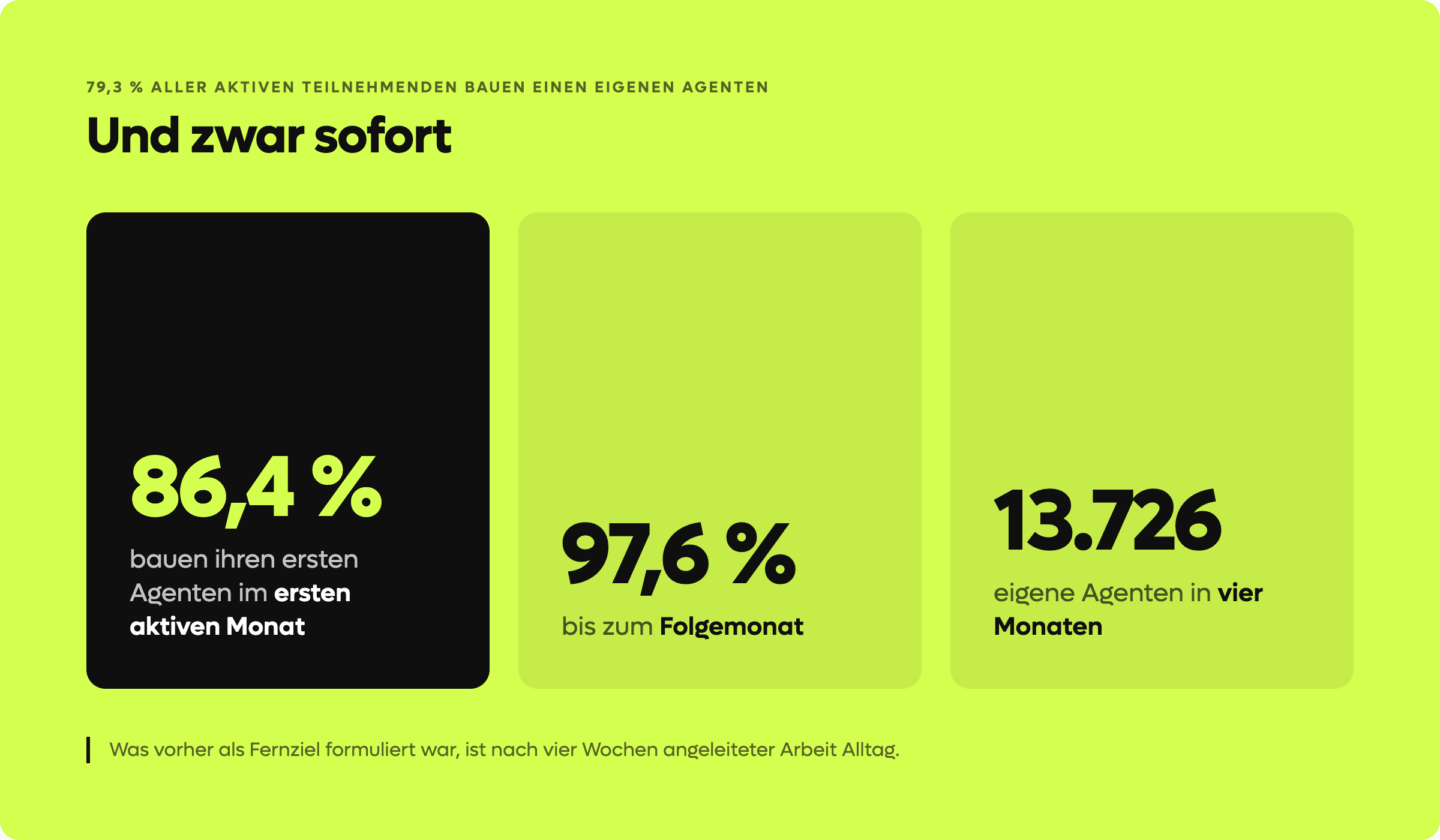
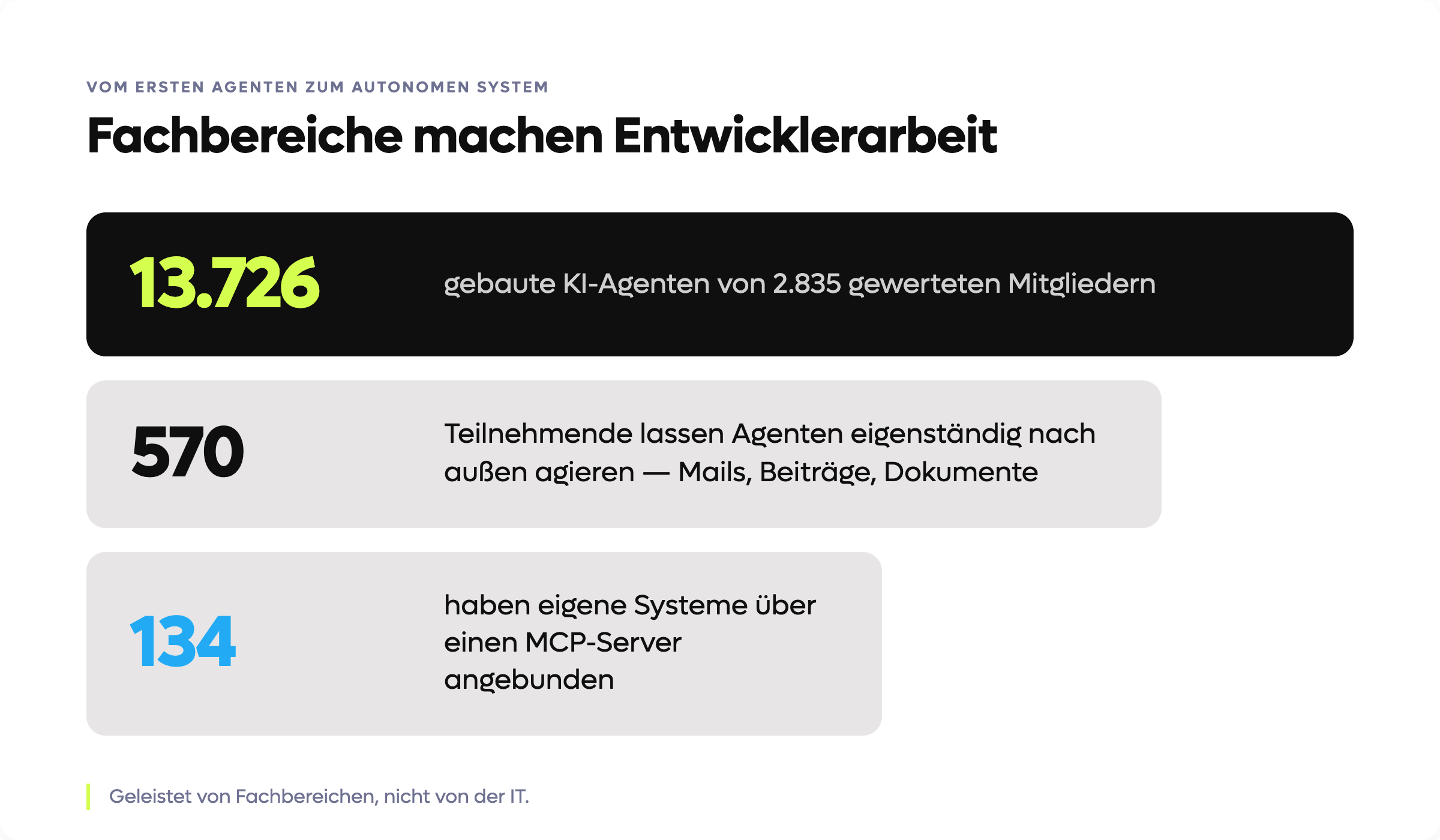
In total, 13,726 AI agents were created in four months. They were built and used by people, most of whom were initially unsure whether they could do it at all.
But that's not all: After the first full month, 570 participants are letting their agents operate independently with external parties—sending emails, publishing posts, and writing documents. 134 have connected their own systems via an MCP server—development work carried out by business units, not by IT.
What This Means for Businesses
The combination of these two insights—that prior experience isn't an advantage and that building competence happens incredibly fast—has a clear implication:
Stop waiting for the AI experts in your organization. They don't exist. Or if they do, they aren't automatically the right people to drive your transformation.
52.1 percent of the respondents in our study rated their own use of AI at a 4 or 5 (note: 5 is the highest rating). When it comes to proficiency, however, only 13.2 percent gave themselves that rating. This reveals an intriguing discrepancy between what people actually do and what they believe they are capable of. Even those who use AI at the highest level on a daily basis rated their proficiency as only moderate.
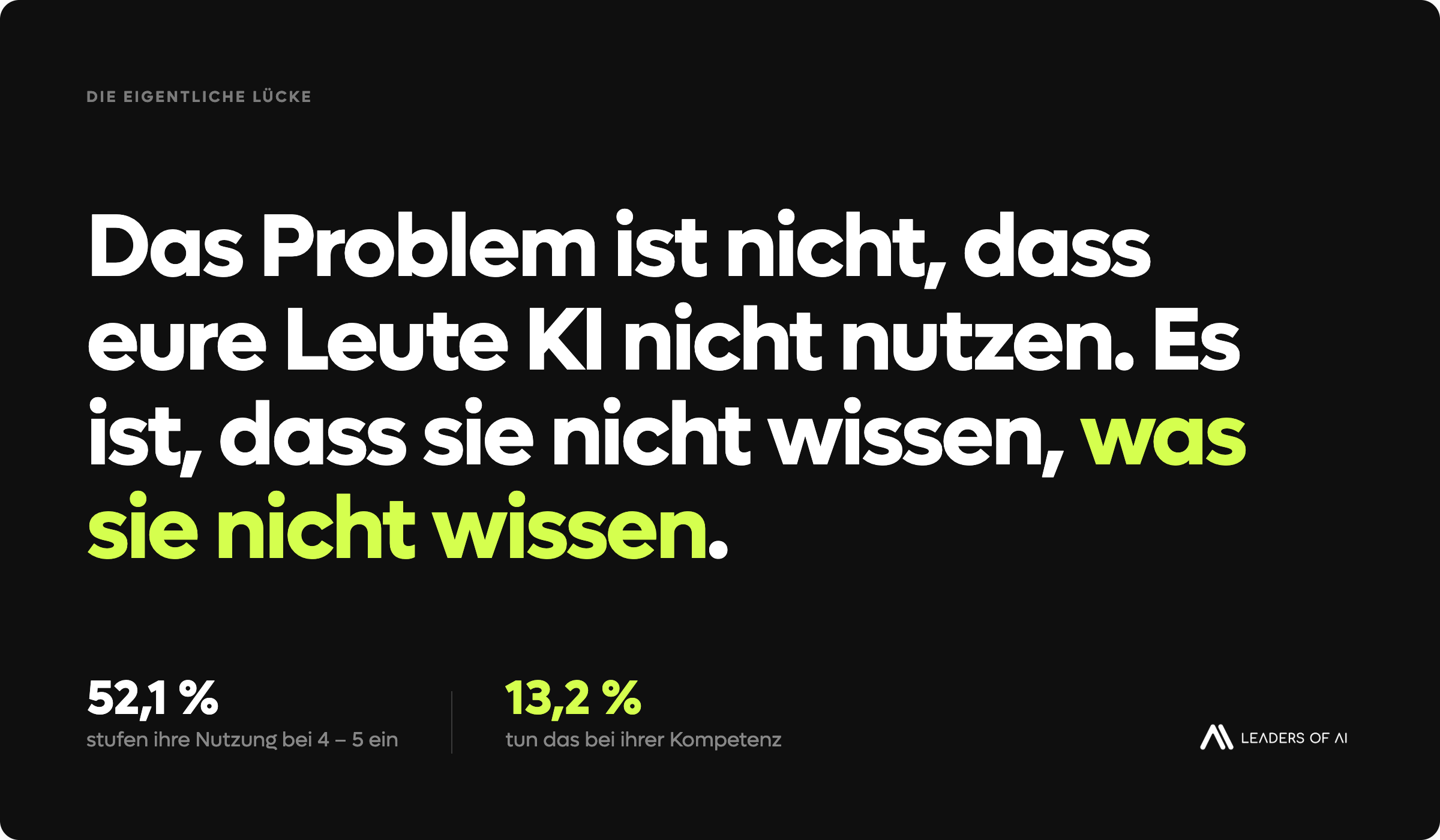
The problem isn't that your people don't use AI. The problem is that they don't know what they don't know. And that those who think they do know are often the ones furthest from true expertise.
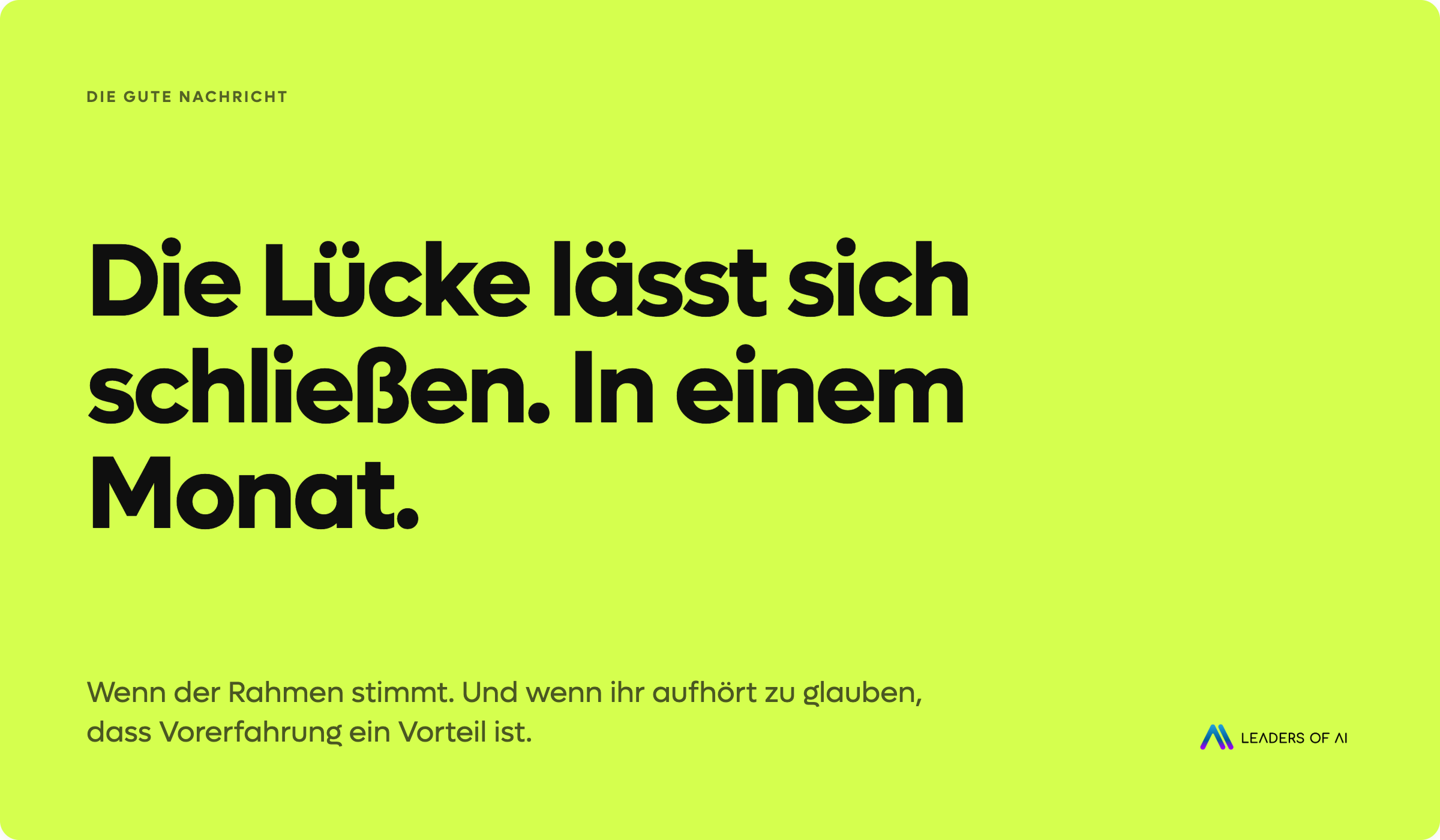
The good news: This gap can be closed quickly—in a month—if the conditions are right, if people are willing to learn, and if we stop believing that prior experience is an advantage.
What the market has to say about this
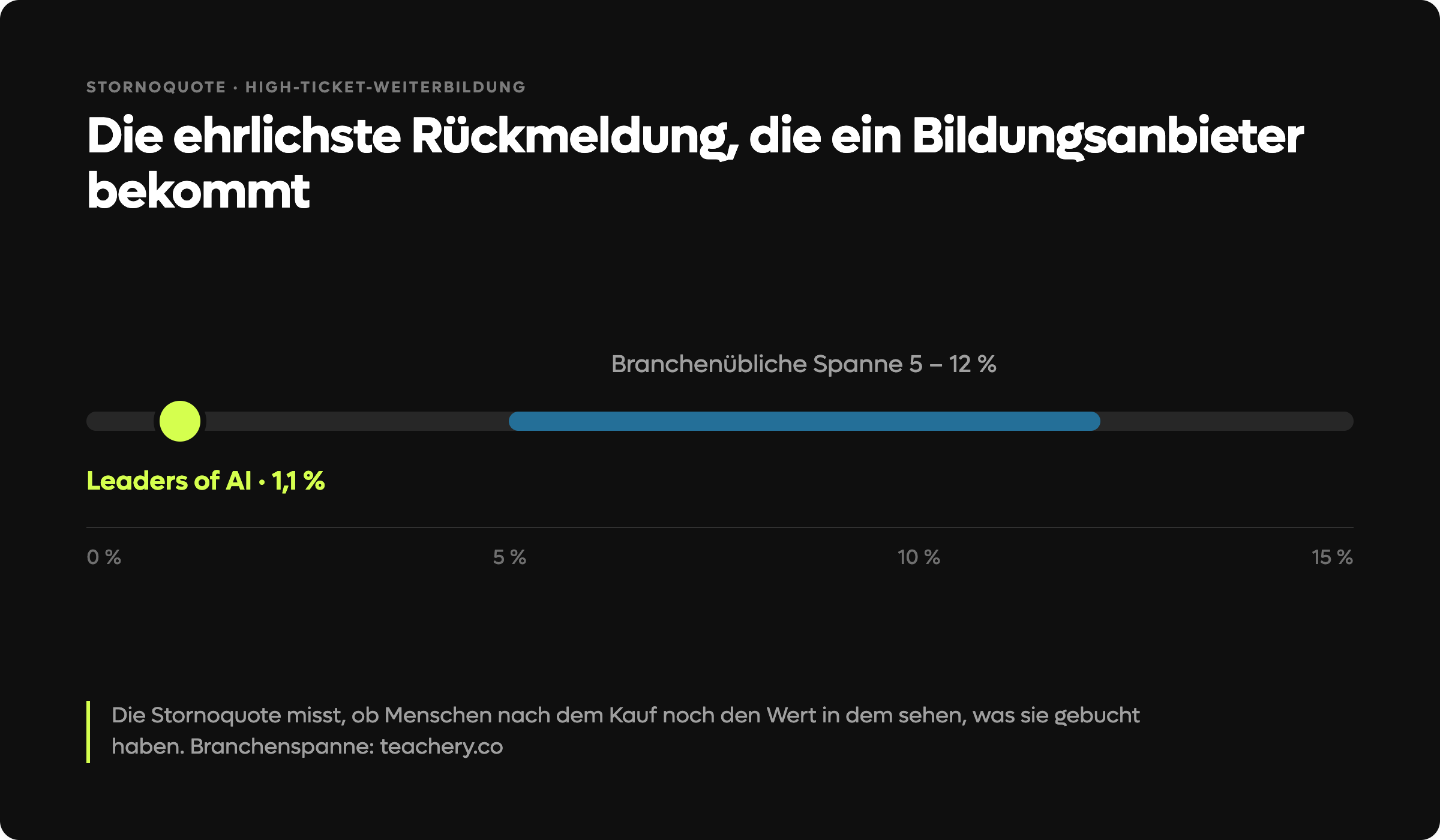
There’s one number that’s hard to sugarcoat: the cancellation rate. It measures whether people still see value in what they’ve booked after making a purchase. At Leaders of AI, it stands at 1.1 percent. In the high-ticket continuing education segment, a range of 5 to 12 percent is considered typical. (Source) This is the most honest feedback an education provider can receive. And it really makes us happy. 🤍
What follows from this
The question is no longer whether AI transformation works. The data shows: It works. Fast . And it’s measurable. Even for people with no prior experience. Perhaps especially for them. The question is: Who is willing to set aside their preconceptions? Who is willing to accept that the so-called AI experts in the organization might not actually be experts at all? Who is willing to learn from scratch instead of relying on routine?
And whoever takes the first step—before it's too late.

Methodology: The study is based on two sources. First, the onboarding data from 7,564 members, of whom 6,071 provided complete self-assessments and learning goals after test entries were excluded. Second, four monthly data exports from our work platform for April through July 2026, with 2,835 evaluated members in July. These two sources cannot be linked at the individual level. All “before-and-after” statements are therefore group comparisons, not individual progress trajectories. Self-assessment is not a measurement: The gap between usage and competence may also reflect modesty, a well-known pattern among people who are aware of their own limitations.