
Your AI operating system can do anything. But your team still isn't using it?


In Part 1 of our blog series, we posed the fundamental question: How should AI be structured within an organization? As a network of specialized agents - or as a centralized system that controls everything? We laid out our own starting point: 53 AI agents, 10 people, and the hypothesis that agents with clearly defined roles are the most successful way to begin the AI transformation.
In the second part , we took a closer look at the agent-based approach. The strengths: scalability, clear roles, and a manageable scope of impact. The weaknesses: the effort required for coordination increases with the number of agents, the risk of silos, and technical complexity. And the tipping point: when the effort required for coordination grows faster than the output. That’s exactly where Part 3 picks up.
What exactly is an AI operating system?
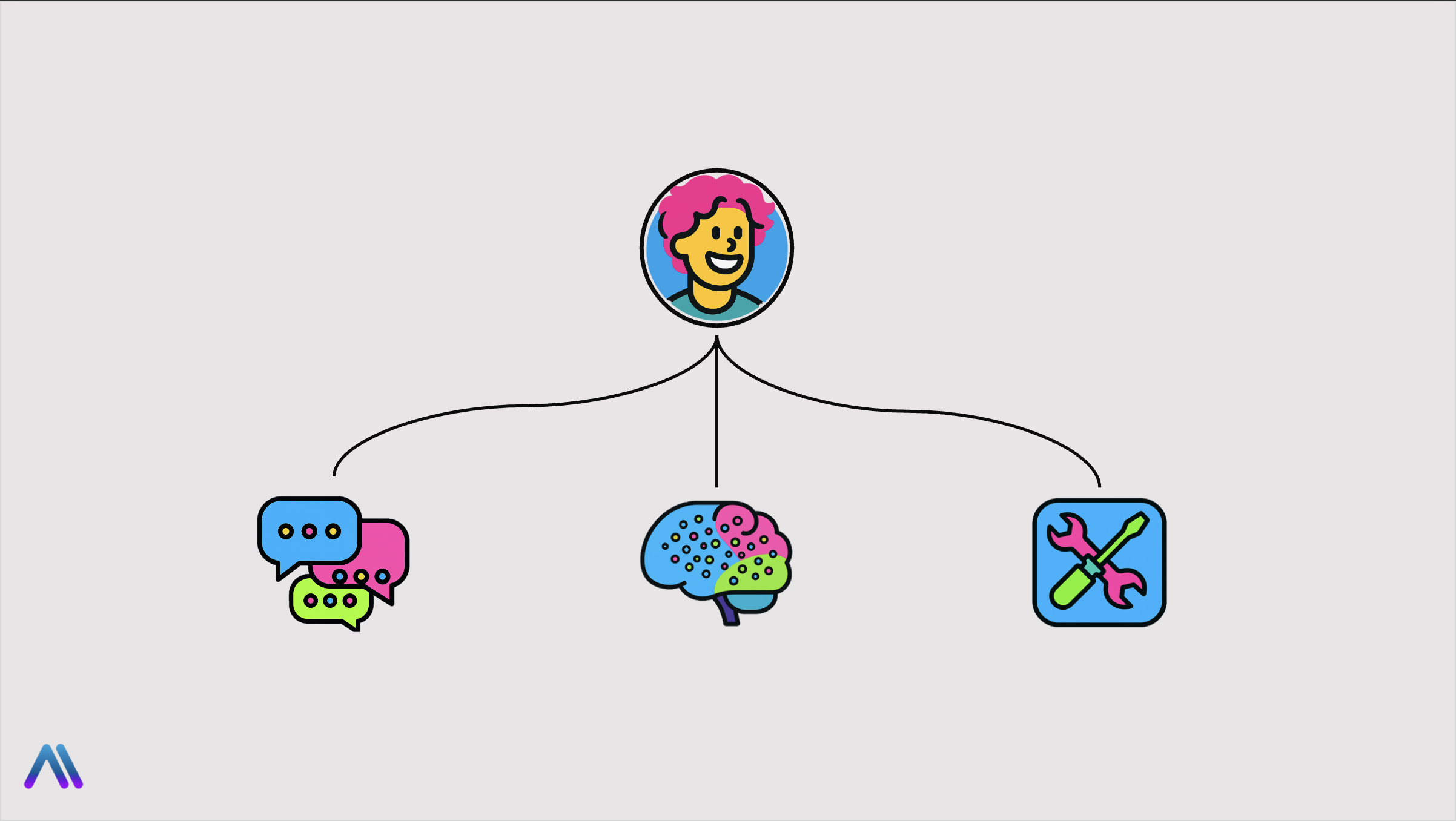
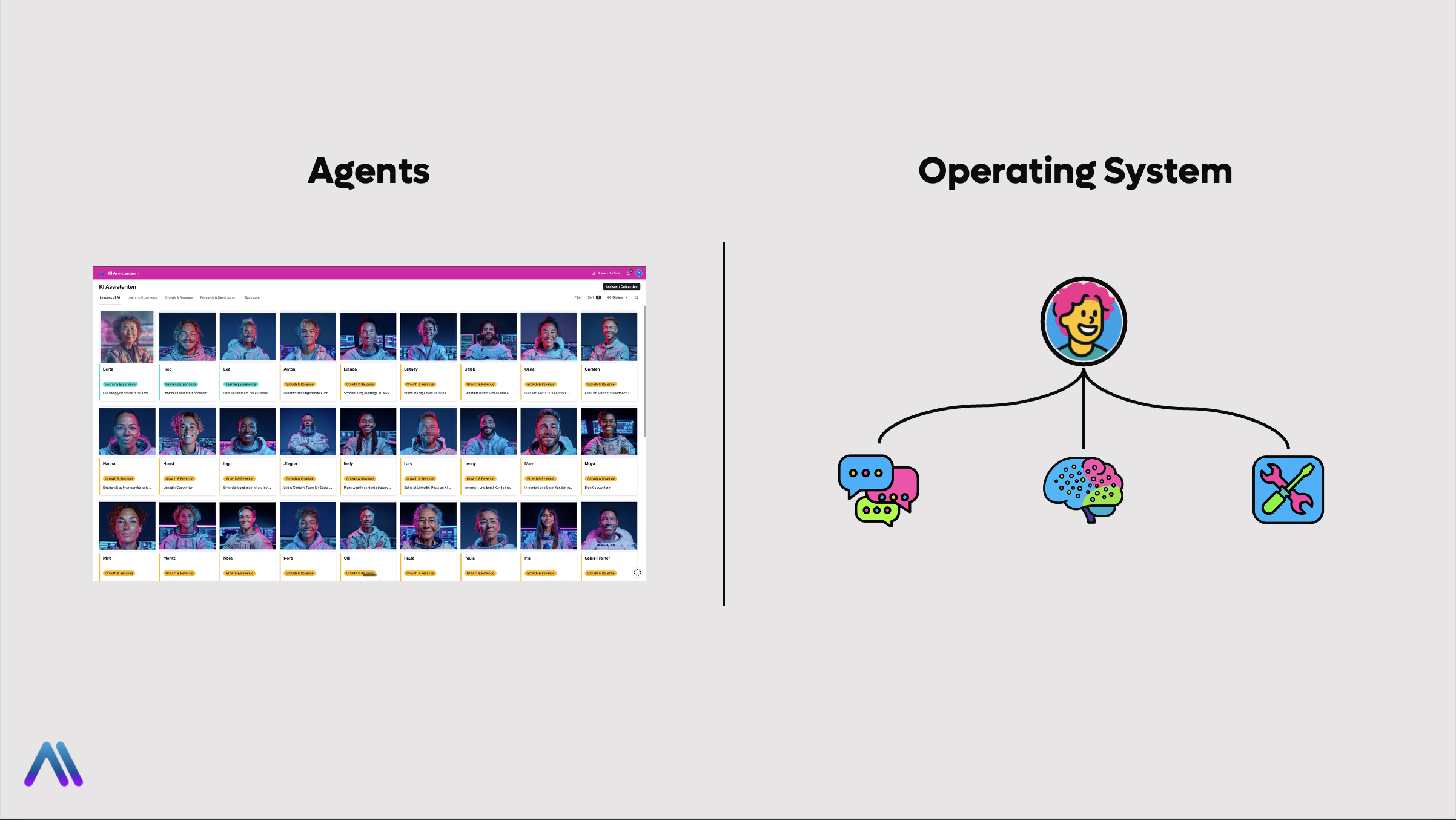
Here, there is a single central agent (let’s call it the “Operating System Agent”) that has access to the company’s entire knowledge base, including all tools, skills, and interfaces. Depending on the task, it autonomously selects the best solution. No predefined roles, no avatars, no names.
The philosophy behind this is radically technology-centered: Create optimal conditions for AI—without restricting it through human structures. Let the machine decide for itself how to solve the problem.
Specific products that embody this approach include Claude Cowork, Claude Code, and Cursor. They all follow the same logic: maximum integration and minimal role definition.
An important term in this context is “SOTA” (State of the Art) models —the most powerful AI models currently available on the market. The operating system approach is based on the idea that these models can find better solutions in open environments than we could define in advance. The AI should not be forced into a rigid framework, but rather allowed to find its own path.
Where the operating system really shines
No more silos. That’s the biggest operational strength. A centralized system knows everything across departments—and links Finance, Sales, and HR in milliseconds. What’s a coordination task in the agent-based approach is structurally resolved by the operating system.
Simpler technical setup. Instead of dozens of wired agents that have to communicate with each other, there is a single central interface—anyone who has ever administered a multi-agent system knows what that means.
Maximum model power. SOTA models aren't limited by narrow role definitions. They can find their own path to a solution—and in certain contexts, that's actually better than any predefined structure.
Highly complex business cases benefit the most. Whenever multiple departments are involved, numerous data sources converge, and data transfers between systems are the main cost drivers—that’s where the operating system really shines.
Where It Reaches Its Limits
Let's turn to the other side of the coin.
Lack of accessibility. No face, no role, no connection. For “non-nerds” - that is, the general workforce of an organization - this is a massive problem. People understand roles. They understand responsibilities. An invisible system running in the background does not build trust - and anything that does not build trust will not be used. In practice, adoption fails more often due to a lack of accessibility than due to a lack of technology.
That is one of the most important findings from our self-experiment.
Fluctuating output quality. Without role specialization and mutual verification, the quality of autonomous results is more variable. In the agent-based approach, one agent verifies the other—using its own, independent context window. In the operating system approach, the system verifies itself using the same context window in which the solution was generated. This means that an incorrect calculation method often goes unnoticed during self-checking because it feels logically consistent. This is essentially a well-known human phenomenon: We are all limited in our ability to evaluate our own work because we are trapped within our own assumptions. A second, independent agent with its own context window challenges precisely those assumptions that the first agent would never question.
The scope of the damage is significantly greater. A single system holds all the keys. One bug, one hack, one vendor outage—and the entire company grinds to a halt. Here’s an example: If the operating system pulls an incorrect number from the CRM during quarterly planning, the error automatically makes its way into finance planning and then into HR planning—the same error, three departments, a single process. With the agent-based approach , a problem remains isolated. If Helga in AI recruiting makes a mistake, accounting doesn’t notice a thing. With the operating system, this separation doesn’t exist.
Governance is becoming complex. When a system knows everything and can do everything, ensuring transparency regarding access rights, data security, and decision-making accountability becomes significantly more difficult. Here’s an example: If HR discusses salaries with the system, the employee could also find out about them. Or here’s another example from our company: During our own test, Claude Cowork used n8n to gain access to tools for which he hadn’t been granted any explicit permissions - because login credentials were stored in n8n that the system could technically access. To be honest, that gave us a bit of a scare.
When does an operating system make sense—and when doesn't it?
Two key questions that will help you make your decision:
1. Is the silo between departments your biggest cost driver?
If so, the operating system is worth a serious look. If, on the other hand, your main problem is adoption and trust, more technology won't solve the problem.
2. Is governance a real priority for you, or is it just a process on paper?
Almost every company has documented access rules and data protection policies. What matters is whether they’re actually put into practice: Are there regular checks to determine who’s authorized to access what? Are there clear lines of responsibility if a system suddenly gains access it was never supposed to have? If governance isn’t treated with the same priority as the project itself, the operating system is a risk you shouldn’t take just yet. Priority first, power second.
Our Conclusions After 6 Months of Personal Experimentation
We tested the AI operating system - alongside our 53 agents. The surprise: It performed impressively on cross-departmental business cases. When we needed to consolidate financial data, pipeline figures, and capacity data from three different systems for quarterly planning, it delivered the results in minutes.
The disappointments: the lack of transparency in decision-making processes, the inconsistent quality of output without role specialization - despite skills such as “Challenging” or consensus-building methods - and the governance issue that we underestimated. What we still can’t answer after six months: How the operating system will behave as model intelligence increases. And whether the governance challenges can be resolved or whether they are simply an inherent part of the approach.
The bottom line:
The agent-based approach is Human-First: It excels where team adoption, trust, and manageable error margins matter. The operating system is AI-First: It plays to its strengths in complex, data-intensive cross-functional tasks where maximum model power makes all the difference. There is no winner here. There is only the right decision for the right context. The fact is: No approach is a religion.
Here's what you can expect in Part 4
We wouldn't be Leaders of AI if we weren't already working on and researching the next wave. We're currently exploring a completely new approach that we've tentatively dubbed "Fluid Teams." But more on that next week in our grand finale… Stay tuned.
Want to know which of our AI programs is right for you?
Anyone who wants to understand how to build, manage, and integrate AI agents into a hybrid organization (or when a more centralized system makes more sense) needs more than just tips on tools.
Master of Business and AI (MBAI): For executives and decision-makers who want to drive AI transformation at the enterprise level.
AI Integration Expert: For anyone who wants to integrate AI into their work and organization on an operational level—delving deeper into architectures, automation, and operational implementation.
Both programs start exactly where AI serves as a lever: clarifying processes, defining roles, and finding the right approach for the right context.
Which one fits your situation? Take the quiz and find out in two minutes.
Sources
- Drop the Hierarchy and Roles: How Self-Organizing LLM Agents Outperform Designed Structures, Victoria Dochkina, Moscow Institute of Physics and Technology, 2026
- Queen-Bee Agents: A BeeSpec-Centered Architecture for Governed Enterprise MCP Orchestration, Dutao Zhang et al., Macao Polytechnic University, 2026
- Measuring Human Leadership Skills with AI Agents, Harvard Kennedy School / NBER, 2025
- Are AI Agents Already Outdated Again?, Leaders of AI Blog, 2026
- The Most Surprising Benefit of AI Agents? Humanity. Leaders of AI Blog, 2026